Premium All-on-4 Dental Implants in Hyderabad
All-on-4 dental implants are an advanced full-arch restoration technique where a complete set of teeth is supported by just four strategically placed implants. This premium all on 4 dental implants in Hyderabad solution is ideal for patients with missing teeth, failing dentition, or loose dentures who want a permanent, natural-looking smile.
At American Smile Clinic, All-on-4 is elevated into a luxury treatment experience, combining:
- Precision digital planning
- Minimally invasive surgical techniques
- High-quality implant systems
- Custom-designed, aesthetic prosthetics
The result: a smile that looks refined, feels natural, and functions like real teeth.
What Are All-on-4 and All-on-X Dental Implants?
All-on-4 is a full-arch dental implant approach in which four strategically positioned implants are used to support a complete arch of fixed teeth in appropriately selected cases.
All-on-X is a broader term for full-arch implant treatment where the number and distribution of implants are determined according to the patient’s individual requirements. Depending on the case, this may include four, six, or another appropriate number of implants.
The appropriate implant number and position are not determined by the number of missing teeth alone. Factors such as jaw anatomy, available bone, restorative design, bite, biomechanics, existing dental condition, and the patient’s overall treatment plan are considered before deciding on the implant configuration.
Who May Be a Candidate for Full-Arch Implant Treatment?
All-on-4 and All-on-X treatment may be considered for patients who have:
- Multiple missing teeth
- Failing or severely damaged teeth
- Loose or poorly fitting dentures
- Difficulty chewing with conventional dentures
- Significant tooth loss affecting daily function
- A need for fixed full-arch tooth replacement
However, full-arch implant treatment is not automatically appropriate for every patient. A detailed clinical examination, diagnostic imaging, and assessment of the remaining teeth, gums, bone, bite, and overall oral health are required before treatment is recommended.
Can Some Teeth Be Saved?
Full-arch implant treatment does not automatically mean that all remaining teeth need to be removed.
The condition of each tooth should be evaluated to determine whether it can be restored and maintained. Factors such as structural damage, infection, periodontal health, bone support, function, and long-term restorability are considered.
Where teeth can be predictably restored and maintained, they may be retained as part of the treatment plan. If certain teeth are severely compromised and cannot provide a suitable long-term foundation, extraction may be recommended.
The decision to extract or preserve teeth therefore follows a clinical evaluation rather than assuming that all remaining teeth require removal.
All-on-4 vs All-on-X: What’s the Difference?
All-on-4 is a specific full-arch treatment approach that uses four implants to support a complete arch of fixed teeth in suitable cases.
All-on-X is a broader term used when the number of implants is determined according to the patient’s clinical and restorative requirements. An All-on-X treatment plan may involve four, six, or another appropriate number of implants.
The implant number and distribution depend on factors such as:
- Jaw anatomy
- Available bone
- Implant position
- Restorative design
- Bite and occlusion
- Biomechanical considerations
- Condition of the remaining teeth and oral tissues
- Overall treatment requirements
For this reason, All-on-4, All-on-6, or another specific configuration should not be assumed to be appropriate before a detailed evaluation.
Initial Consultation, CBCT and Digital Planning
Full-arch implant treatment begins with a comprehensive consultation and diagnostic assessment.
Depending on the case, this may include:
- Clinical examination
- CBCT imaging
- Digital scans and dental records
- Assessment of the remaining teeth
- Evaluation of bone structure
- Gum and periodontal assessment
- Bite analysis
- Restorative planning
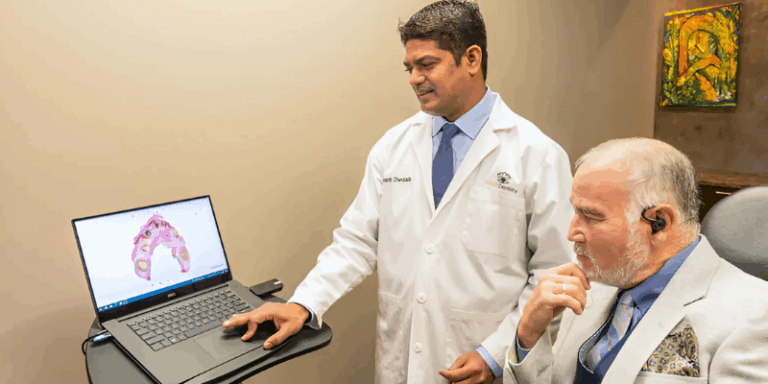
CBCT imaging provides three-dimensional information about the jawbone and surrounding anatomical structures. Digital records can then be used alongside the clinical findings to help plan implant positions and the intended restoration.
The surgical and restorative aspects of treatment are considered together so that implant placement supports the planned final teeth.
Surgery and Extractions When Required
If some teeth cannot be restored or maintained, extraction may be recommended as part of the treatment plan.
Implant placement is then planned according to the available bone, anatomy, restorative design, and selected treatment approach. Some patients may also require procedures such as bone grafting or sinus augmentation.
The timing of extractions and implant placement varies between patients. In some cases, extraction and implant placement may be performed during the same treatment phase. Other cases may require staged treatment and healing before implants can be placed.
How Implant Position Is Recorded and the Provisional Teeth Are Designed
The position of the implants is important because the provisional and final prostheses need to correspond with the implants, bite, and surrounding oral structures.
Digital records and clinical measurements can be used to document implant positions and assist with restorative planning.
The provisional prosthesis is designed around factors such as:
- Implant position
- Tooth proportions
- Facial appearance
- Bite
- Speech
- Chewing function
- Available restorative space
This provisional stage can also provide an opportunity to evaluate the function and appearance of the restoration before the final prosthesis is fabricated.
Fixed Provisional Teeth and Immediate Loading
In selected cases, patients may receive fixed provisional teeth shortly after implant placement. This approach may be referred to as immediate loading or “Teeth in a Day.”
Immediate fixed provisional teeth are not appropriate for every patient. Whether they can be provided depends on clinical conditions such as implant stability, bone quality and quantity, implant position, bite forces, oral health, and the overall treatment plan.
When sufficient implant stability and other required conditions are present, a fixed provisional restoration may be provided during the early stage of treatment.
When immediate loading is not appropriate, the implants may need to heal before a fixed restoration is placed. Treatment can therefore be staged according to the patient’s individual healing requirements.
It is also important to distinguish between provisional and final teeth. “Teeth in a Day” generally refers to the possibility of receiving fixed provisional teeth shortly after implant placement; it does not necessarily mean that the final permanent prosthesis is completed on the same day.
Provisional Teeth vs Final Prosthesis
Provisional Teeth
Provisional teeth are temporary fixed teeth used during the healing and implant integration period.
They are designed to provide appropriate function and appearance while the implants heal. Their materials, design, construction, and final aesthetic characteristics may differ from those of the final prosthesis.
Final Prosthesis
The final prosthesis is provided after the appropriate healing and evaluation period.
It is custom-designed according to the implant positions, bite, facial appearance, functional requirements, available space, and selected restorative materials.
Before delivery, the fit, bite, tooth position, appearance, and function are assessed and adjusted as required.
Healing and Follow-Up
After implant placement, the implants require time to integrate with the surrounding bone. The healing period varies depending on the individual case, implant location, bone condition, treatment approach, and any additional procedures performed.
During follow-up appointments, the clinical team can assess:
- Implant stability
- Healing of the tissues
- Bite and occlusion
- Condition of the provisional prosthesis
- Oral hygiene
- Overall progress toward the final restoration
Patients should follow the recommended care instructions during the healing period and attend scheduled appointments before moving to the final prosthesis.
Final Full-Arch Prosthesis and Maintenance
Once healing is complete and the implants have been appropriately assessed, the final full-arch prosthesis can be designed and fitted.
The final restoration is planned according to the patient’s implant positions, bite, facial appearance, functional requirements, and restorative goals. Depending on the individual case, different prosthetic materials and designs may be considered.
Before the final prosthesis is delivered, the fit and bite are checked. Appropriate adjustments are made to ensure the restoration works with the patient’s individual occlusion.
Full-arch implant treatment also requires ongoing maintenance. Patients should maintain good oral hygiene and attend regular professional appointments so that the implants, gums, bone, prosthesis, and bite can be monitored.
The long-term performance of an implant-supported restoration varies between patients and depends on factors including oral hygiene, maintenance, bite forces, general health, implant condition, and prosthesis condition. No specific lifespan can be guaranteed for every patient.
One Arch or Both Arches?
Full-arch treatment may involve one dental arch or both the upper and lower arches.
If significant tooth loss or failing teeth are limited to one arch, treatment may be planned for that arch alone. When both arches require rehabilitation, treatment may involve the upper and lower arches.
The decision depends on the condition of the teeth and supporting tissues, bite relationship, functional requirements, aesthetics, and the patient’s overall treatment goals.
Treating both arches is not automatically necessary for every patient.
Risks, Limitations and Possible Complications
Full-arch implant treatment is a surgical and restorative procedure and carries potential risks and limitations.
Possible complications may include:
- Infection or inflammation
- Discomfort during healing
- Implant failure
- Bone loss
- Gum or soft-tissue problems
- Prosthetic complications
- Bite-related problems
- Damage to surrounding anatomical structures
- Sinus-related complications in relevant cases
Additional risks may apply when procedures such as bone grafting or sinus augmentation are required.
Not every patient is suitable for immediate loading or a particular implant configuration. Bone condition, gum health, oral hygiene, bite forces, medical history, smoking or tobacco use, and other individual factors can affect treatment planning and healing.
Regular maintenance and professional follow-up are important for monitoring the implants and prosthesis over time.
All-on-4 and All-on-X Treatment for NRI and International Patients
American Smile Clinic in Financial District, Nanakramguda, Hyderabad, provides consultations for NRIs and international patients considering full-arch implant treatment.
Patients travelling for treatment can discuss their dental history, previous treatment, existing diagnostic records, and treatment requirements during the consultation process.
Where available, previous dental records and imaging may be reviewed before the patient’s visit. However, an in-person clinical examination and appropriate diagnostic imaging are generally required before a definitive treatment plan can be confirmed.
The overall treatment timeline varies according to the patient’s clinical condition and may involve multiple visits when extractions, staged implant placement, healing, or additional procedures are required.
Cost of All-on-4 and All-on-X Treatment
The cost of full-arch implant treatment varies according to the individual treatment plan.
Factors that can affect the cost include:
- Number of implants required
- Implant system and components
- Bone condition
- Extractions when required
- Bone grafting or sinus augmentation
- Digital imaging and planning
- Provisional prosthesis
- Final prosthesis
- Additional surgical or restorative procedures
- Follow-up and maintenance requirements
A personalized consultation is required to determine the appropriate treatment approach and provide an accurate cost estimate. Patients should receive a clear explanation of which procedures, restorations, and follow-up services are included in the quoted treatment plan.
Advanced Full-Arch Implant Care at American Smile Clinic
American Smile Clinic provides full-arch implant treatment using clinical assessment, CBCT imaging, digital treatment planning, implant placement, provisional restorations when appropriate, and customized final prosthetics.
The treatment approach is planned around the individual patient’s dental condition rather than using the same implant number or restoration design for every case.
For patients considering All-on-4, All-on-X, or another implant-supported full-arch option, the first step is a detailed evaluation to understand the condition of the teeth, gums, bone, bite, and overall treatment requirements.
Plan Your Full-Arch Implant Consultation
If you are considering All-on-4 or All-on-X dental implants in Hyderabad, a detailed consultation can help determine which full-arch treatment options may be appropriate for you.
At American Smile Clinic, patients can discuss implant configuration, extractions when required, provisional teeth, final prosthesis options, treatment stages, costs, risks, and long-term maintenance.
Consult Dr. Srikanth Cherukadu at American Smile Clinic in Financial District, Nanakramguda, Hyderabad, for an individualized full-arch implant evaluation and treatment plan.
Popular searches:
Dental Implant Bridge Treatment in Hyderabad | Zirconia Dental Implants in Hyderabad | Best Implantologist in Hyderabad | Dental Implant Surgeon in Hyderabad