
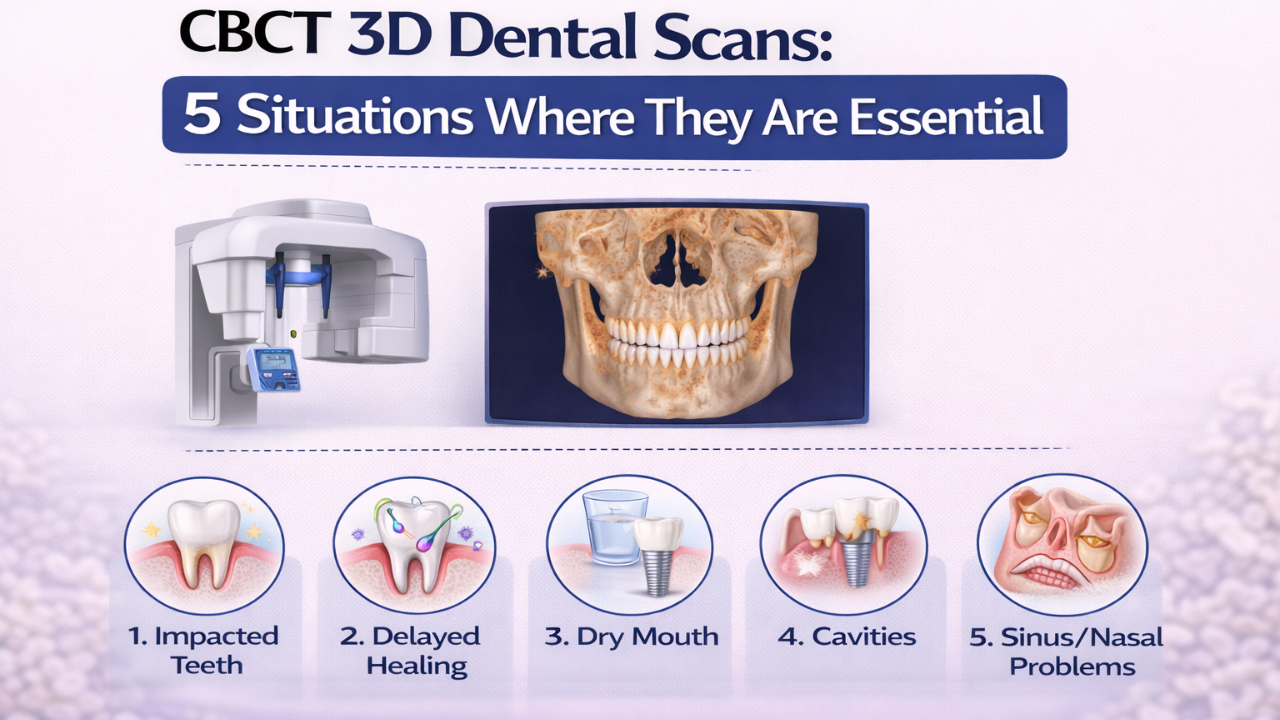
Dental diagnosis has moved far beyond traditional X-rays. While 2D imaging still has its place, it often falls short when precision is critical. That’s where CBCT (Cone Beam Computed Tomography) 3D scans come in—offering a detailed, three-dimensional view of teeth, bone, nerves, and surrounding structures.
At our American Smile Clinic, CBCT is not used routinely for every case—but in certain situations, it becomes absolutely essential. By Dr. Srikanth’s approach, advanced imaging is recommended only when it significantly improves diagnosis, safety, and treatment outcomes. Here are five situations where CBCT scans are truly non-negotiable.
1. Dental Implant Planning
Implants require precise placement within the jawbone. Even a small error in positioning can affect stability, aesthetics, or nearby nerves.
CBCT scans help to:
- Measure bone height, width, and density
- Identify nerve locations and sinus boundaries
- Plan exact implant positioning
At our clinic, implant treatments are guided by CBCT-based digital planning to ensure accuracy and long-term success.
2. Complex Root Canal Cases
Standard X-rays provide limited information when dealing with complex root canal anatomy.
CBCT becomes essential when:
- Multiple or hidden canals are suspected
- Previous root canal treatment has failed
- Infections are deep or unclear
By Dr. In Srikanth’s experience, CBCT often reveals details that are not visible in 2D imaging—leading to more precise and successful treatment.
3. Impacted or Wisdom Teeth Evaluation
Impacted teeth, especially wisdom teeth, can be positioned close to nerves or other critical structures.
CBCT scans help to:
- Determine exact tooth position
- Assess proximity to nerves
- Plan safe and controlled extraction
This significantly reduces the risk of complications during surgery.
4. Jawbone and Facial Structure Analysis
In cases involving jaw issues or advanced treatment planning, understanding bone structure is critical.
CBCT is used for:
- Full mouth rehabilitation planning
- TMJ (jaw joint) evaluation
- Bone loss assessment
At our American Smile Clinic, this ensures treatments are not just effective—but also structurally sound.
5. Detecting Hidden Infections or Pathologies
Some dental infections and conditions are not clearly visible in traditional X-rays.
CBCT can detect:
- Cysts or lesions
- Hidden infections in bone
- Cracks or fractures in teeth
This allows early diagnosis and prevents complications from undetected issues.
Why CBCT Is a Game-Changer in Dentistry
The key advantage of CBCT is clarity. Instead of a flat image, it provides a complete 3D view, allowing dentists to see structures from multiple angles.
Benefits include:
- More accurate diagnosis
- Better treatment planning
- Reduced risk of errors
- Improved long-term outcomes
At our clinic, CBCT is integrated into a digital workflow that prioritizes precision and patient safety.
Is CBCT Safe?
CBCT scans use controlled radiation levels and are considered safe when used appropriately.
Important points:
- Radiation exposure is higher than regular X-rays but still within safe limits
- Used only when clinically necessary
- Provides benefits that outweigh the minimal risk
By Dr. Srikanth’s approach, CBCT, is recommended only when it adds real value to the treatment process.
Final Thoughts
CBCT 3D scans are not required for every dental procedure—but in the right situations, they are indispensable. The difference between a routine treatment and a highly precise one often comes down to how well the problem is visualized.
At our American Smile Clinic, CBCT is used strategically to enhance diagnosis, improve safety, and deliver predictable results. By Dr. Srikanth’s experience, seeing more clearly leads to treating more accurately—and ultimately achieving better outcomes for patients.
FAQs – CBCT Dental Scans
What is a CBCT scan used for?
It is used for detailed 3D imaging of teeth, bone, and surrounding structures.
Is CBCT better than a regular X-ray?
Yes, it provides more detailed and accurate information in complex cases.
Is the scan painful?
No, it is a quick and completely painless procedure.
How long does a CBCT scan take?
Usually a few minutes.
Do all patients need a CBCT scan?
No, it is recommended only when advanced imaging is necessary.