A straight, healthy-looking smile is an important part of appearance for people who regularly work in front of cameras. This is one reason clear aligner treatment has attracted attention among celebrities, actors, influencers, athletes, and working professionals. Unlike traditional fixed braces, clear aligners are removable and designed to be discreet during everyday activities.
However, celebrity use should not be the deciding factor when choosing orthodontic treatment. Invisalign treatment is not automatically suitable for everyone, and the right treatment depends on the patient’s teeth, bite, gum health, jaw relationship, treatment objectives, and ability to follow the prescribed wear schedule.
The American Association of Orthodontists notes that clear aligners can treat conditions such as crowded teeth, spacing, overbite, underbite, open bite, crooked teeth, and crossbite, but also emphasizes that aligners are not appropriate for every patient. An orthodontist should determine whether aligners, braces, or another approach is most suitable for the individual case.
Why Are Celebrities Interested in Invisalign?
For people whose careers involve television, films, advertising, photography, or social media, the appearance of orthodontic appliances can be an important consideration.
Clear aligners are designed to be discreet and can be removed for eating, drinking, brushing, and flossing. This makes them attractive to adults who want orthodontic treatment while maintaining their normal professional and social routines.
Common reasons people consider Invisalign include:
- Nearly invisible appearance
- Removable design
- Easier brushing and flossing compared with fixed braces
- Customized digital treatment planning
- Fewer food restrictions than fixed appliances
- Suitability for many adult orthodontic cases
However, convenience does not mean Invisalign is the right treatment for every smile. A proper orthodontic assessment is essential before treatment begins.
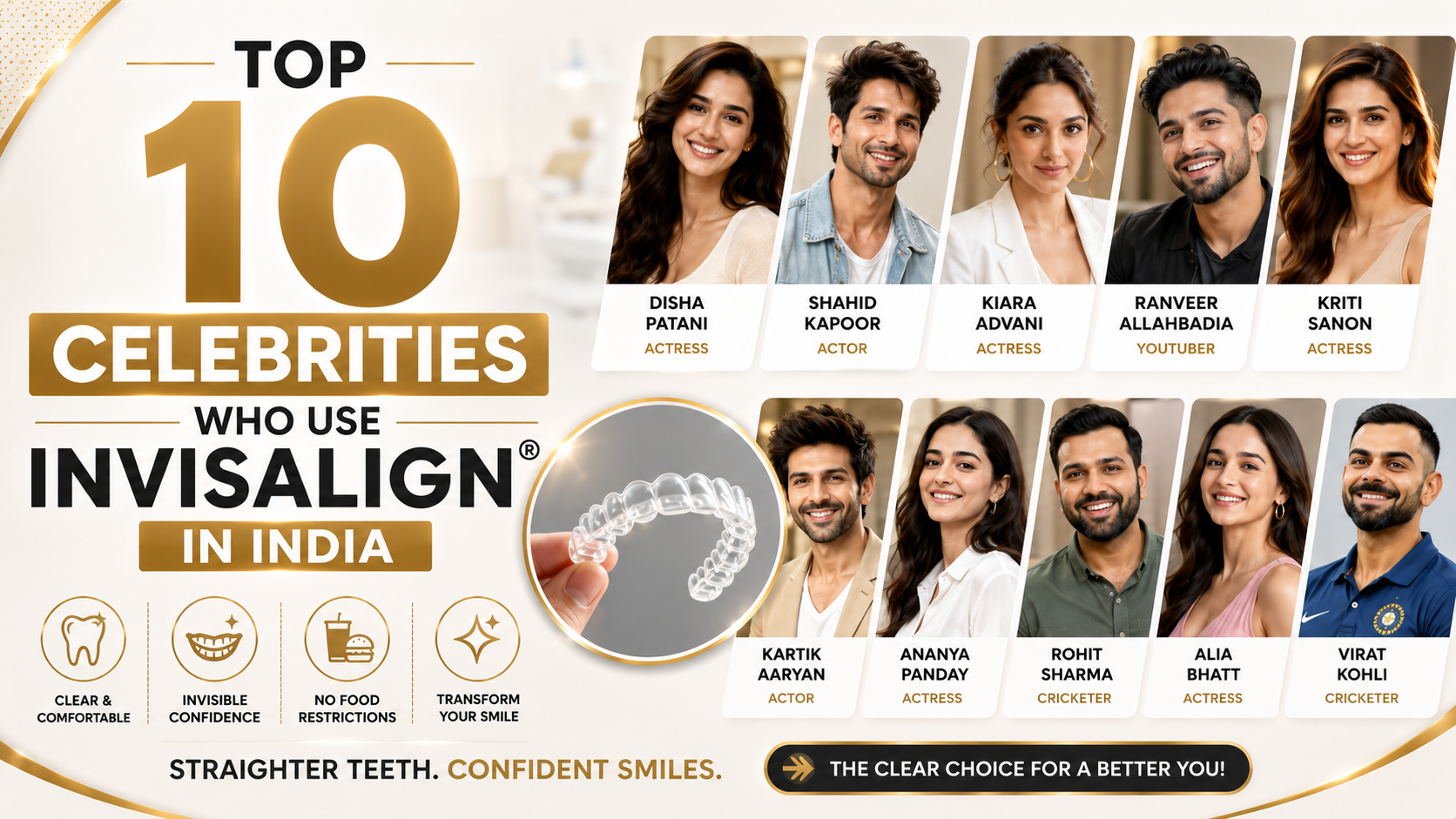
Top 10 Celebrities Associated With Invisalign or Clear Aligners
The following personalities have been publicly associated with Invisalign, clear aligners, or invisible orthodontic treatment. Celebrity treatment histories are not always publicly documented in sufficient clinical detail, so these examples should not be interpreted as evidence that the same treatment is appropriate for every patient.
1. Kusha Kapila
Content creator and actress Kusha Kapila has been associated with invisible aligner treatment and has helped bring greater awareness of adult orthodontic treatment to younger Indian audiences.
Her association with clear aligners also reflects a broader trend: adults increasingly want to address crowding, spacing, or other alignment concerns without wearing conventional metal braces.
2. Nikki Galrani
South Indian actress Nikki Galrani has been associated with clear aligner treatment and orthodontic awareness. For actors who regularly appear on camera, discreet orthodontic appliances can be an appealing option.
Nevertheless, the suitability of Invisalign depends on the individual’s diagnosis rather than their profession or lifestyle.
3. Virat Kohli
Indian cricketer Virat Kohli has been associated with clear aligner and smile-correction awareness campaigns. His public visibility has contributed to wider consumer awareness of discreet orthodontic options.
A celebrity association, however, should be viewed as awareness rather than a clinical recommendation. Orthodontic treatment must be planned according to the patient’s specific dental and skeletal characteristics.
4. Anushka Sharma
Anushka Sharma has also been associated with aligner-related awareness alongside Virat Kohli. Her visibility has helped introduce clear aligner treatment to audiences who may previously have considered traditional braces the only option.
Modern aligner systems can address a broad range of tooth-alignment and bite concerns, but treatment complexity still needs to be assessed by a qualified dental professional.
5. Parineeti Chopra
Parineeti Chopra has been referenced in discussions around invisible braces and modern orthodontic treatment. For public figures, the discreet appearance of clear aligners can be particularly attractive.
For patients considering Invisalign, the more important question is not whether a celebrity has used aligners, but whether the patient’s own teeth and bite can be predictably treated with them.
6. Shah Rukh Khan
Shah Rukh Khan has been mentioned in various dental and orthodontic discussions concerning smile enhancement and discreet orthodontic treatment. Public information about specific orthodontic treatment should be interpreted cautiously unless confirmed directly by the individual or treating clinician.
This distinction is important because a celebrity’s appearance alone cannot establish which orthodontic procedure was used.
7. Haripriya
Actress Haripriya has been associated with clear aligner treatment and discussions surrounding smile correction. Her example highlights the growing interest in discreet orthodontic solutions among entertainment professionals.
For anyone considering treatment, the same clinical principle applies: an examination should determine whether clear aligners can achieve the required tooth movements.
8. Nivetha Pethuraj
South Indian actress Nivetha Pethuraj has been associated with clear aligner awareness and modern orthodontic treatment. Clear aligners can be particularly appealing to professionals who want to maintain a natural appearance during treatment.
However, treatment success depends on accurate diagnosis, appropriate treatment planning, and consistent aligner wear.
9. Justin Bieber
Internationally, Justin Bieber has been associated with Invisalign and clear aligner treatment. His visibility helped make discreet orthodontic treatment more familiar to younger audiences worldwide.
His example also illustrates why clear aligners have become popular beyond traditional orthodontic patients: adults increasingly want to correct their teeth without prominently visible brackets and wires.
10. Zendaya
Zendaya has also been associated with Invisalign and discreet orthodontic treatment during her career. For performers, removable clear aligners can offer practical advantages when compared with highly visible fixed appliances.
Nevertheless, the same clinical assessment is required whether the patient is a celebrity, professional, student, or teenager.
Who Is a Good Candidate for Invisalign?
This is a more important question than which celebrities use Invisalign.
Clear aligners may be suitable for patients with a range of orthodontic concerns, including:
- Crowded or overlapping teeth
- Gaps between teeth
- Crooked teeth
- Certain overbites
- Certain underbites
- Open bites
- Crossbites
- Relapse after previous orthodontic treatment
- Some more complex tooth and bite problems
The American Association of Orthodontists confirms that aligners can be used for several common orthodontic conditions, but stresses that treatment selection depends on the individual’s orthodontic needs.
Invisalign’s current clinical information also describes treatment options for conditions ranging from crowding and spacing to deep bite, crossbite, open bite, overbite, underbite, and certain extraction cases.
When May Invisalign Not Be the Best Option?
One of the biggest misconceptions about clear aligners is that they are automatically the best alternative to braces.
They are not.
Some patients may require treatment approaches that include traditional braces, orthodontic elastics, attachments, tooth extraction, temporary anchorage devices, or a combination of orthodontic techniques.
The American Association of Orthodontists notes that some cases may be treated more predictably with braces and that an orthodontist should determine whether clear aligners are appropriate.
Poor gum health is another important consideration. Orthodontic tooth movement should not be undertaken without addressing significant periodontal problems because moving teeth in unhealthy supporting tissues can increase the risk of complications.
Factors That May Affect Invisalign Suitability
Your dentist or orthodontist may evaluate:
- Severity of crowding
- Amount of spacing
- Type and severity of bite problem
- Tooth rotations
- Tooth position and root position
- Gum and periodontal health
- Existing dental restorations
- Jaw relationships
- Need for extractions or other procedures
- Ability to wear aligners consistently
This is why an online quiz or celebrity comparison cannot replace an in-person orthodontic assessment.
Can Invisalign Treat Complex Orthodontic Cases?
Modern Invisalign treatment can address considerably more than minor cosmetic tooth movement.
According to current Invisalign clinical information, treatment may be used for complex concerns such as severe crowding, deep bites, open bites, underbites, crossbites, overbites, significant tooth rotations, and some extraction cases. Complex treatment may involve attachments, elastics, interproximal reduction (IPR), and digital treatment planning.
However, this does not mean every complex case should be treated with Invisalign.
The key question is whether the required tooth movements can be achieved predictably using the available orthodontic mechanics and whether aligner treatment is appropriate for that particular patient.
In some cases, braces or a hybrid approach may provide better control of specific movements. The AAO has specifically discussed hybrid strategies that combine clear aligners with braces for complex orthodontic movements.
What Happens During an Invisalign Consultation?
A proper Invisalign consultation should involve more than simply checking whether your teeth look crooked.
A dentist or orthodontist may evaluate your:
Teeth and Alignment
The clinician examines crowding, spacing, rotations, tooth positions, and the overall alignment of your dental arches.
Bite
Your overbite, underbite, crossbite, open bite, and other relationships between the upper and lower teeth are assessed.
Gum and Bone Health
Healthy supporting tissues are important before orthodontic tooth movement begins. Existing gum disease or other oral health problems may need treatment first.
Digital Records and Treatment Planning
Depending on the case, your provider may use photographs, digital scans, X-rays, and other diagnostic records to develop an individualized treatment plan.
Digital treatment planning allows the clinician to evaluate the proposed sequence of tooth movements before treatment starts. Invisalign’s ClinCheck system is designed for this type of customized planning.
Why Patient Compliance Matters With Invisalign
Unlike fixed braces, clear aligners depend heavily on patient cooperation.
Patients generally need to wear their aligners for the prescribed amount of time each day and change them according to their treatment plan.
Removing aligners unnecessarily or failing to wear them as instructed can interfere with planned tooth movement and may extend treatment.
This is particularly important for busy professionals who are attracted to Invisalign because of its convenience. The aligners may be removable, but they still need to be worn consistently for treatment to progress as planned.
Invisalign vs Braces: Which Is More Suitable?
There is no universal answer.
| Factor | Invisalign | Traditional Braces |
|---|---|---|
| Appearance | Discreet clear aligners | More visible brackets and wires |
| Removable | Yes | No |
| Eating | Aligners are removed for meals | Food restrictions may apply |
| Oral hygiene | Aligners can be removed for brushing | Requires cleaning around brackets and wires |
| Complex treatment | Can treat many complex cases | Established option for complex cases |
| Patient compliance | High compliance is important | Less dependent on removable-appliance compliance |
| Attachments/elastics | May be required | May be required |
| Treatment choice | Depends on diagnosis | Depends on diagnosis |
The important point is that Invisalign is not inherently better than braces. Both are orthodontic treatment methods, and the appropriate option depends on the patient’s diagnosis, treatment objectives, oral health, and the clinician’s assessment.
How Long Does Invisalign Treatment Take?
There is no single treatment duration that applies to every patient.
Treatment time depends on factors such as:
- Degree of crowding
- Type of bite correction required
- Number and complexity of tooth movements
- Patient compliance
- Need for IPR, attachments, elastics, or other procedures
- Whether refinements are required
Some relatively straightforward cases can be completed in a shorter period, while complex orthodontic treatment may take considerably longer.
Patients should therefore be cautious of advertisements promising a specific treatment duration without first evaluating their teeth and bite.
What Are the Limitations of Clear Aligners?
Clear aligners have advanced considerably, but they still have clinical and practical limitations.
Some tooth movements may be more difficult to control with removable aligners, and certain complex cases may benefit from braces or a combination of treatment methods.
Patient compliance is also a major factor because aligners must be worn consistently.
Additionally, aligners do not correct every dental problem simply because the teeth appear crooked. A patient may have underlying bite, jaw, periodontal, or restorative issues that need to be addressed before or alongside orthodontic treatment.
For this reason, professional diagnosis and monitoring remain essential.
Is Invisalign Suitable for Adults in India?
Yes, adults can receive clear aligner treatment when they are clinically suitable candidates.
Adult patients commonly seek orthodontic treatment for crowding, spacing, relapse after previous braces, and bite-related concerns. However, adult treatment requires consideration of existing dental restorations, gum health, bone support, missing teeth, and other oral health factors.
The American Association of Orthodontists recommends starting with an accurate diagnosis and customized treatment plan rather than selecting a treatment method solely based on preference.
Why You Should Choose a Clinician-Led Invisalign Treatment
Choosing clear aligners should begin with a clinical assessment rather than a celebrity comparison.
A qualified dentist or orthodontist can determine:
- Whether Invisalign is appropriate
- Which teeth need to move
- Whether attachments are required
- Whether IPR may be necessary
- Whether elastics are needed
- Whether braces may provide better control
- How long treatment may reasonably take
- What retention will be required after treatment
Invisalign itself states that its aligners are provided through trained dental professionals because treatment is customized and requires professional oversight.
Final Thoughts: Is Invisalign Right for You?
Celebrities and public figures have helped make clear aligners more visible in popular culture, but their treatment choices should not be used as a substitute for professional orthodontic advice.
The right question is not “Which celebrity uses Invisalign?” but “Can Invisalign safely and predictably treat my specific orthodontic problem?”
Clear aligners can treat many conditions, from straightforward crowding and spacing to a range of more complex bite problems. At the same time, some patients may achieve more predictable results with braces or a combination of orthodontic techniques.
If you are considering Invisalign in Hyderabad, a clinical consultation is the best starting point. A dentist or orthodontist can evaluate your teeth, bite, gum health, and treatment goals before recommending the most appropriate approach.
If you’re looking for Invisalign treatment in Hyderabad, American Smile Clinic can evaluate your orthodontic needs and discuss whether clear aligners are appropriate for your case.
Results vary by patient. Invisalign suitability, treatment duration, and treatment approach should be determined by a qualified dental professional after an individual assessment.
FAQs About Invisalign Treatment
Can anyone get Invisalign?
No. Invisalign can treat many orthodontic conditions, but it is not appropriate for every patient. A dentist or orthodontist needs to evaluate your teeth, bite, oral health, and treatment objectives before recommending clear aligners.
Can Invisalign treat crowded teeth?
Yes. Clear aligners can be used for many cases involving crowded or crooked teeth. More severe crowding may require additional treatment planning, space creation, attachments, IPR, or other orthodontic techniques.
Can Invisalign fix an overbite or underbite?
Invisalign can treat certain overbite and underbite cases, but suitability depends on the severity and underlying cause of the bite problem. Some complex cases may require additional orthodontic mechanics or alternative treatment.
Is Invisalign better than braces?
Neither treatment is universally better. Invisalign offers advantages such as removability and discreet appearance, while braces may provide advantages for certain complex tooth movements. Your orthodontist can recommend the appropriate option based on your individual diagnosis.
How long does Invisalign treatment take?
Treatment duration varies according to the complexity of the case, required tooth movements, compliance, and whether additional treatment or refinements are needed. A personalized estimate can be provided after an orthodontic assessment.
Do I need to wear Invisalign aligners all day?
Clear aligner treatment depends on consistent wear according to your clinician’s instructions. Removing aligners for longer than recommended can affect treatment progress, so following the prescribed wear schedule is an important part of successful treatment.
Can Invisalign treat severe orthodontic problems?
Modern Invisalign treatment can address many complex orthodontic conditions, including some severe crowding and bite problems. However, not every complex case is suitable for clear aligners, and some patients may benefit from braces or combined treatment approaches.
What should I do before choosing Invisalign?
Start with a comprehensive dental or orthodontic consultation. Your clinician can assess your teeth, bite, gums, existing dental work, and treatment goals and then determine whether Invisalign, braces, or another approach is most appropriate.