When multiple teeth are damaged, missing, worn down, or failing, you may come across two terms during your research: full mouth rehabilitation and full mouth dental implants.
They can sound like the same treatment. They are not.
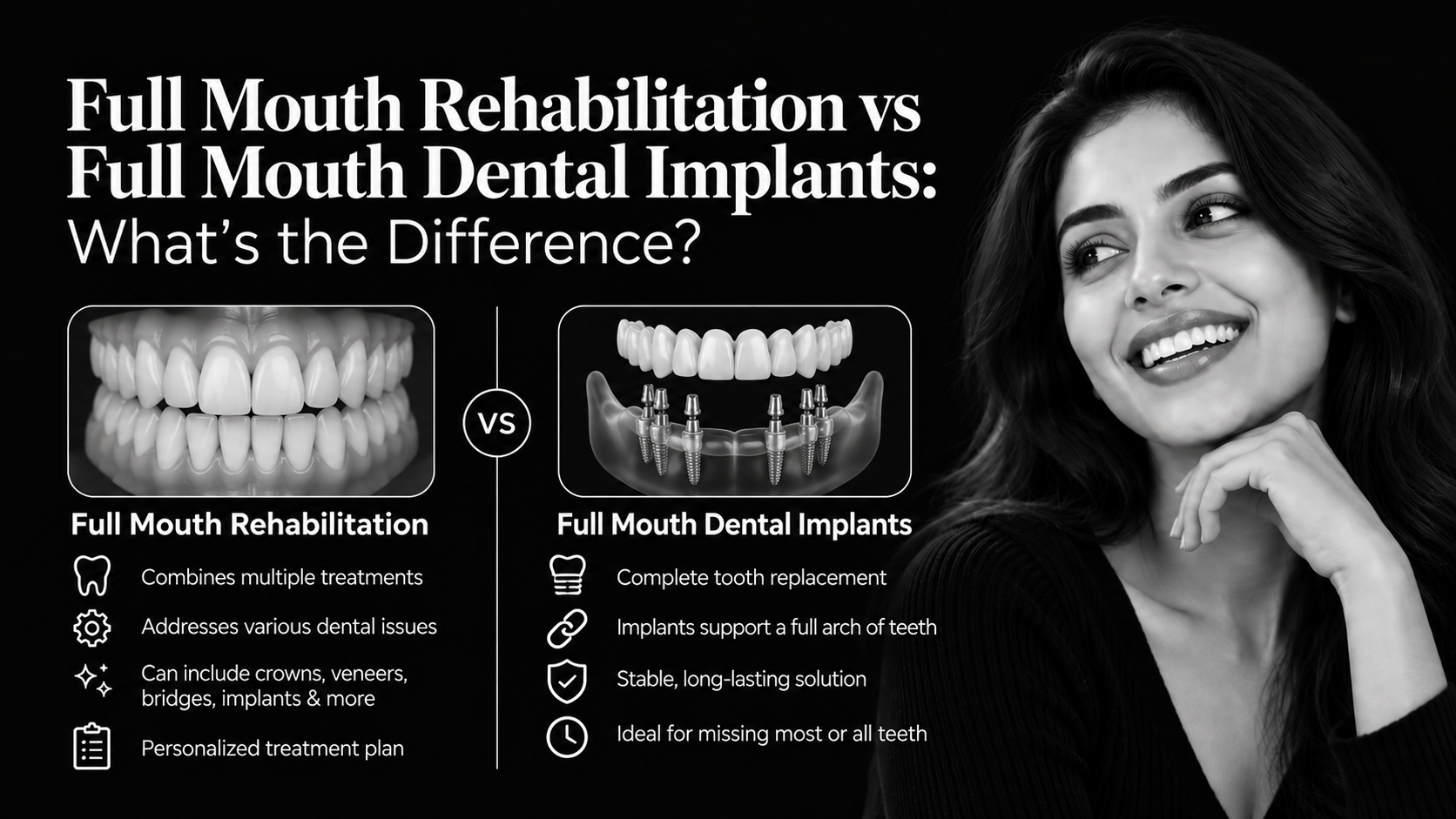
Full mouth rehabilitation is a comprehensive treatment approach that can combine restorative, cosmetic, preventive, and functional dental procedures to rebuild a patient’s overall oral health. Full mouth dental implants, on the other hand, are a specific tooth-replacement solution in which dental implants support a fixed set of replacement teeth.
The distinction matters because not every patient with extensive dental problems needs every natural tooth removed and replaced with implants.
Some patients may be able to preserve several natural teeth through crowns, bridges, root canal treatment, or other restorative procedures. Others may have extensive tooth loss or failing dentition and may be better candidates for implant-supported full-arch treatment.
American Smile Clinic in Hyderabad offers both comprehensive rehabilitation and implant-based treatment, using digital diagnostics and individualized treatment planning for complex cases.
Full Mouth Rehabilitation vs Full Mouth Dental Implants at a Glance
| Feature | Full Mouth Rehabilitation | Full Mouth Dental Implants |
| What is it? | Comprehensive treatment approach | Implant-supported tooth replacement |
| Main objective | Restore oral health, function, bite and aesthetics | Replace missing/failing teeth with fixed implant-supported teeth |
| Natural teeth preserved? | Often, where clinically possible | Teeth that cannot be predictably retained may be removed |
| Implants required? | Not necessarily | Yes |
| Crowns/bridges | May be used | Usually part of the final restoration |
| Root canals | May be included | May be needed on teeth being preserved |
| Veneers | May be included | May be used in selected aesthetic situations |
| Suitable for | Complex, mixed dental problems | Extensive tooth loss or failing dentition |
| Treatment design | Highly individualized | Implant and full-arch focused |
The most important point is that full mouth rehabilitation does not automatically mean full mouth implants.
What Is Full Mouth Rehabilitation?
Full mouth rehabilitation is a comprehensive approach to restoring the condition and function of the entire mouth.
Rather than treating each tooth as an isolated problem, the dentist evaluates the relationship between:
- Teeth
- Gums
- Bite
- Jaw function
- Missing teeth
- Tooth wear
- Existing restorations
- Smile aesthetics
- Overall oral health
The treatment plan may combine several procedures depending on what the patient actually needs.
For example, one patient might require:
- Root canal treatment
- Crowns
- Bridges
- Dental implants
- Veneers
- Bite correction
- Gum treatment
- Cosmetic dentistry
Another patient may need only crowns, bridges, and a few implants.
The current American Smile Clinic treatment guide describes full mouth rehabilitation as a combination of restorative, cosmetic, and functional dentistry designed to rebuild severely damaged or worn teeth.
What Is Full Mouth Dental Implant Treatment?
Full mouth dental implants are designed for patients who have extensive tooth loss, multiple failing teeth, or a situation where many natural teeth cannot be predictably restored.
Instead of relying on removable dentures, strategically placed dental implants are used to support fixed replacement teeth.
The implants function as artificial tooth roots, while the final restoration replaces the visible teeth.
American Smile Clinic’s full mouth dental implants in Hyderabad page describes full-arch implant treatment using strategically placed implants to support fixed, natural-looking teeth.
Depending on the case, treatment may involve:
- All-on-4 implants
- All-on-6 implants
- Fixed full-arch prostheses
- Implant-supported bridges
- Bone grafting
- Sinus lift procedures
- Immediate temporary teeth in selected cases
The exact approach depends on bone availability, the condition of the existing teeth, bite, medical history, aesthetics, and treatment objectives.
The Biggest Difference: Preserving Natural Teeth
One of the biggest differences between the two approaches is what happens to the patient’s existing teeth.
Full Mouth Rehabilitation
The goal is generally to preserve healthy and restorable natural teeth whenever possible.
For example, suppose you have:
- Four heavily worn teeth
- Two teeth requiring crowns
- One tooth requiring a root canal
- Three missing teeth
- Several teeth with cosmetic concerns
A comprehensive rehabilitation plan could potentially preserve the rest of your healthy teeth while replacing only the missing teeth and restoring the damaged ones.
Full Mouth Dental Implants
Full-mouth implant treatment becomes relevant when many teeth are missing, severely damaged, or considered non-restorable.
In these situations, remaining failing teeth may need to be removed and replaced with an implant-supported full arch.
This is why full-mouth implants should not be viewed simply as a more extensive version of conventional dental treatment.
They represent a different treatment pathway.
Does Full Mouth Rehabilitation Always Include Implants?
No.
Dental implants can be part of full mouth rehabilitation, but they are not mandatory.
A comprehensive rehabilitation plan could include:
Natural teeth + crowns + bridges + root canals + implants + cosmetic procedures
The combination depends entirely on the patient’s clinical condition.
For example, a missing molar might be replaced with an implant, while a damaged premolar could be restored with a crown and a worn front tooth could receive an aesthetic restoration.
This flexibility is one of the major advantages of comprehensive rehabilitation.
Does Full Mouth Implant Treatment Include Crowns?
Yes, but the terminology can be confusing.
A dental implant itself is not the visible tooth.
The implant is placed into the jawbone and acts as the artificial root. A prosthetic tooth or full-arch restoration is then attached to the implant system.
Depending on the case, the final restoration can be an individual implant crown, an implant-supported bridge, or a full-arch prosthesis.
For patients who still have natural teeth that can be restored, conventional crowns may also be part of a broader treatment plan.
American Smile Clinic offers both implant dentistry and restorative treatments, allowing treatment planning to be based on the condition of individual teeth rather than applying one solution to the entire mouth.
When Is Full Mouth Rehabilitation More Appropriate?
Full mouth rehabilitation may be considered when you have a combination of dental problems rather than complete tooth loss.
It can be relevant for patients experiencing:
- Severe tooth wear
- Multiple broken teeth
- Extensive decay
- Several missing teeth
- Old or failing restorations
- Bite problems
- Aesthetic concerns
- Multiple teeth requiring crowns
- Teeth requiring root canal treatment
- A combination of functional and cosmetic problems
The important characteristic is that different teeth may require different treatments.
One tooth may be healthy and need nothing.
Another may need a crown.
Another may require root canal treatment.
Another may be missing and require an implant.
A full mouth rehabilitation plan brings all of those decisions together.
When Are Full Mouth Dental Implants More Appropriate?
Full-mouth dental implants may be considered when a patient has:
- Multiple missing teeth
- Severely failing teeth
- Extensive tooth loss
- Teeth that cannot be predictably restored
- Advanced tooth deterioration
- Difficulty using removable dentures
- A desire for fixed replacement teeth
American Smile Clinic’s implant service specifically describes full-arch implant solutions for patients with extensive tooth loss or failing dentition.
However, candidacy must be determined through a detailed clinical and radiographic evaluation.
What About All-on-4 and All-on-6?
All-on-4 and All-on-6 are implant-based approaches that can support a full arch of replacement teeth using four or six strategically positioned implants.
The number of implants is only one part of the treatment decision.
The dentist also needs to consider:
- Bone volume
- Bone density
- Implant positioning
- Bite
- Gum health
- Facial aesthetics
- Existing teeth
- Prosthetic design
- Long-term maintenance
American Smile Clinic’s full-mouth implant treatment includes both All-on-4 and All-on-6 approaches, along with fixed full-mouth restorations and other implant solutions.
The best approach is therefore not necessarily the one with the greatest number of implants.
It is the one that provides an appropriate balance of stability, function, aesthetics, biology, and long-term maintainability.
Full Mouth Rehabilitation Can Include Cosmetic Dentistry
Full mouth rehabilitation is not only about repairing damaged teeth.
For some patients, the final objective also includes improving the appearance of the smile.
A comprehensive plan may combine functional treatment with cosmetic procedures such as:
- Dental veneers
- Smile designing
- Teeth whitening
- Gum contouring
- Cosmetic bonding
American Smile Clinic’s cosmetic dentistry in Hyderabad service includes veneers, smile makeovers, whitening, cosmetic bonding, and gum contouring as part of its aesthetic treatment options.
This is particularly important when extensive restorative treatment involves the front teeth, where function and appearance need to work together.
What Role Does Smile Design Play?
When a patient needs extensive dental reconstruction, simply making every tooth “look good” is not enough.
The teeth also need to work together.
Smile planning can consider:
- Tooth proportions
- Facial symmetry
- Tooth color
- Gum display
- Smile line
- Tooth length
- Bite
- Relationship between upper and lower teeth
For patients whose rehabilitation includes significant aesthetic work, smile designing in Hyderabad can help integrate aesthetic planning with the broader treatment strategy.
The goal is to avoid a situation where individual restorations look good separately but do not create a harmonious overall result.
What If Some Teeth Can Be Saved With Root Canal Treatment?
This is where comprehensive treatment planning becomes particularly important.
A tooth with infected pulp may sometimes be preserved through root canal treatment rather than removed.
If that tooth has enough remaining structure, it may subsequently receive a crown or another restoration.
That can allow the patient to retain a natural tooth rather than replacing it with an implant.
This is one reason full mouth rehabilitation and full-mouth implant treatment should not be treated as interchangeable terms.
The first question should always be:
Which teeth can be predictably saved, and which cannot?
What Happens During Full Mouth Rehabilitation?
The process varies significantly between patients, but it often follows a structured sequence.
1. Comprehensive Examination
The dentist evaluates the teeth, gums, bite, jaw function, existing restorations, and overall oral health.
2. Digital Diagnostics
Depending on the case, digital scans, X-rays, photographs, and CBCT imaging may be used.
3. Treatment Planning
The dentist identifies which teeth can be preserved and which require restoration or replacement.
4. Disease Control
Active decay, infection, gum disease, or other problems are addressed before definitive reconstruction.
5. Restorative Treatment
Depending on the case, this can include crowns, bridges, root canals, fillings, implants, or other restorative procedures.
6. Functional and Aesthetic Refinement
The bite, tooth proportions, smile aesthetics, and final restorations are evaluated together.
7. Maintenance
Long-term success depends on regular dental examinations, hygiene, and appropriate maintenance.
What Happens During Full Mouth Dental Implant Treatment?
The process is different because implant placement becomes a central part of treatment.
Step 1: Assessment
The dentist evaluates bone, gums, existing teeth, bite, and overall health.
Step 2: Digital Implant Planning
CBCT and 3D planning can be used to evaluate bone and determine implant positions.
American Smile Clinic states that its implant workflow uses CBCT imaging and 3D-guided surgery for precision.
Step 3: Tooth Removal When Necessary
Teeth that cannot be predictably restored may need extraction.
Step 4: Implant Placement
Implants are strategically positioned in the jaw.
Step 5: Temporary Teeth
In selected cases, temporary fixed teeth may be provided relatively soon after implant placement. The clinic’s full-mouth implant page notes that selected patients may receive fixed temporary teeth within approximately 24–48 hours.
Step 6: Healing
The implants require time to integrate with the surrounding bone.
Step 7: Final Prosthesis
After healing and appropriate clinical evaluation, the final full-arch restoration is fabricated and placed.
Is Full Mouth Rehabilitation More Conservative?
It can be, depending on the patient’s condition.
If several natural teeth are healthy or restorable, preserving them can avoid unnecessary extraction and implant placement.
This is why a comprehensive rehabilitation approach can sometimes involve a combination of natural teeth and implants rather than replacing everything.
However, conservative does not mean that it is always the better option.
If teeth are severely compromised and have a poor long-term prognosis, repeatedly repairing them may not provide a predictable outcome.
The treatment should therefore be based on long-term prognosis, not simply on avoiding implants.
Is Full Mouth Dental Implant Treatment Better Than Dentures?
For appropriately selected patients, implant-supported full-arch teeth can provide greater stability than conventional removable dentures.
American Smile Clinic describes full-mouth implants as providing fixed teeth, improved chewing and speech, natural aesthetics, and jawbone-support benefits compared with removable solutions.
However, implants involve surgery, healing, maintenance, and greater treatment complexity.
They are not automatically the best choice for every patient.
Full Mouth Rehabilitation vs Full Mouth Implants: Which Costs More?
There is no universal answer.
Full mouth rehabilitation can involve anything from several crowns and bridges to a complex combination of implants, cosmetic procedures, and restorative treatment.
Full-mouth implant treatment involves surgical implant placement and a full-arch prosthesis, so the investment can also be substantial.
According to American Smile Clinic’s current 2026 price guide:
- Full Mouth Rehabilitation: approximately ₹2,50,000–₹10,00,000+
- All-on-4 Dental Implants: approximately ₹3,50,000–₹8,00,000
- Dental Implants: approximately ₹30,000–₹80,000 per implant
These are indicative ranges, and the final cost depends on the patient’s clinical requirements, materials, number of implants, prosthetic design, and additional procedures.
For a broader overview of current treatment pricing, you can review the latest dental treatment price guide in Hyderabad.
Which Treatment Takes Longer?
Again, there is no single timeline.
A rehabilitation involving several crowns and fillings may follow a different timeline from one involving multiple implants and bone grafting.
Full-mouth implant treatment can involve:
Diagnosis → implant surgery → temporary teeth → healing → final prosthesis
The full-mouth implant process therefore includes a biological healing period that conventional restorative treatment may not require.
At the same time, complex rehabilitation can also take months if multiple procedures must be completed in stages.
Which Option Is Better for You?
A useful way to think about the decision is:
Choose a rehabilitation approach when:
- Many natural teeth are still healthy
- Several damaged teeth can be predictably restored
- You have a mixture of missing and damaged teeth
- You want to preserve viable natural teeth
- Your treatment requires crowns, bridges, root canals, and possibly some implants
- Your main problem is a combination of functional and aesthetic dental issues
Consider full-mouth implants when:
- Many teeth are missing
- Multiple remaining teeth have a poor prognosis
- You have severely failing dentition
- You want fixed full-arch replacement teeth
- Conventional dentures are not meeting your functional needs
- Your bone and overall health are suitable for implant treatment
The final decision should come after a comprehensive examination.
Can Full Mouth Rehabilitation Include Full Mouth Implants?
Yes.
This is an important point that is often overlooked.
Full mouth rehabilitation is the broader treatment concept.
Full-mouth dental implants can be one component or pathway within a comprehensive rehabilitation plan.
For example, a patient may have:
- A full-arch implant restoration on the upper jaw
- Several natural teeth preserved on the lower jaw
- Crowns on some lower teeth
- An implant bridge replacing several missing teeth
- Cosmetic treatment on selected front teeth
That entire plan could be considered a comprehensive rehabilitation even though implants are only one part of it.
Full Mouth Treatment at American Smile Clinic
American Smile Clinic’s current service offering specifically includes dental implants, full-mouth rehabilitation, cosmetic dentistry, smile makeovers, root canal treatments, and functional dentistry.
This broad treatment capability is particularly relevant for complex cases because the final plan does not have to be built around a single procedure.
The clinic’s implant service also includes single implants, multiple-tooth solutions, All-on-4, full-mouth implants, implant bridges, bone grafting, and immediate-load options in selected cases.
For patients travelling from outside Hyderabad or India, the clinic also offers dental tourism in Hyderabad with treatment planning for international and NRI patients.
Frequently Asked Questions
Is full mouth rehabilitation the same as full mouth dental implants?
No. Full mouth rehabilitation is a comprehensive treatment approach that can involve several procedures. Full-mouth dental implants are a specific implant-supported tooth-replacement solution.
Does full mouth rehabilitation require implants?
No. It can involve crowns, bridges, root canals, veneers, fillings, gum treatment, orthodontics, implants, or combinations of these treatments.
Are full-mouth dental implants suitable for everyone?
No. Implant treatment requires evaluation of bone, gums, overall oral health, bite, and other clinical factors.
Can natural teeth be preserved during full mouth rehabilitation?
Yes. When teeth are healthy or can be predictably restored, preserving them may be part of the treatment plan.
Are full-mouth implants permanent?
Implant-supported restorations are designed as long-term solutions, but they still require professional maintenance and good oral hygiene.
What are All-on-4 and All-on-6?
They are full-arch implant approaches using four or six strategically placed implants to support a set of replacement teeth.
Is full mouth rehabilitation cheaper than full-mouth implants?
Not necessarily. Cost depends on the procedures required. A complex rehabilitation involving many crowns, implants, and other treatments can be substantial.
How long does full-mouth implant treatment take?
The timeline varies. Selected patients may receive temporary fixed teeth within 24–48 hours, but final restoration generally follows a healing period.
Can full mouth rehabilitation improve appearance as well as function?
Yes. A comprehensive plan can combine functional restoration with cosmetic treatments such as veneers, smile design, whitening, crowns, and gum contouring.
How do I know which treatment I need?
A comprehensive clinical examination and appropriate digital imaging are necessary to determine which teeth can be saved, which need restoration, and whether implants are appropriate.
Final Takeaway: Full Mouth Rehabilitation or Full Mouth Dental Implants?
The difference comes down to scope versus solution.
Full mouth rehabilitation is the broader strategy. Full-mouth dental implants are one specific solution within the world of comprehensive tooth replacement.
If you still have several healthy or restorable teeth, a rehabilitation plan may allow you to preserve them while addressing damaged, missing, worn, or aesthetically compromised teeth.
If you have extensive tooth loss or multiple teeth that cannot be predictably saved, full-mouth dental implants may provide a fixed and stable replacement option.
The goal should not be to choose the most extensive treatment.
It should be to choose the treatment that provides the best long-term combination of oral health, function, aesthetics, comfort, and predictability for your individual situation.
Ready to Discuss Full Mouth Treatment in Hyderabad?
If you are dealing with multiple missing, damaged, worn, or failing teeth, the first step is a comprehensive assessment rather than choosing between treatments based on terminology alone.
American Smile Clinic in Financial District, Nanakramguda, Hyderabad, combines advanced digital diagnostics, implant dentistry, restorative care, cosmetic dentistry, and full-mouth treatment planning under one roof.
A personalized consultation can help determine whether your teeth can be preserved through comprehensive rehabilitation, whether implant-supported treatment is appropriate, or whether a combination of both provides the most predictable long-term solution.