A cracked or damaged tooth does not always mean that extraction is the only solution. In many cases, a tooth can be preserved when the damage is assessed early and the right treatment is selected according to the location and severity of the problem. The key question is not simply whether a tooth is cracked, but whether enough healthy structure remains to restore it predictably.
A small enamel chip, a fracture that reaches the inner pulp, and a crack extending toward the root are very different clinical situations. For patients searching for an experienced dentist in Hyderabad, an early examination can help determine whether the natural tooth can still be preserved or whether replacement should be considered.
Modern restorative dentistry focuses on maintaining natural teeth whenever a predictable result is possible. Depending on the condition of the tooth, treatment may involve bonding, a filling, a crown, root canal treatment, or a combination of restorative procedures. When a tooth is too severely damaged to save, replacement options such as dental implants in Hyderabad may be considered.
Can a Cracked Tooth Be Saved?
Whether a cracked tooth can be saved depends on several factors, including the depth and direction of the crack, the condition of the pulp, the health of the surrounding gums and bone, and how much healthy tooth structure remains.
A superficial crack may only require monitoring or a conservative restoration. A deeper fracture may need more extensive treatment to protect the remaining tooth from further damage.
This is why the appearance of a crack alone is not enough to determine the treatment. Some fractures can be difficult to see, while a tooth that looks relatively intact may already have deeper structural or pulpal involvement.
Minor Chips and Enamel Damage
A small chip involving only the outer tooth structure can often be managed conservatively. Depending on the location and size of the defect, a tooth-coloured restoration may be used to rebuild the missing area.
The practical objective is to restore both appearance and function. A repaired front tooth, for example, should be evaluated not only for colour matching but also for the way the teeth come together during normal biting.
Even after a minor repair, patients should avoid habits such as biting ice, opening packages with their teeth, or chewing very hard objects. These habits can place unnecessary stress on both the tooth and restoration.
Cracks That Reach the Inner Tooth
A deeper crack may extend toward the pulp, the soft tissue containing nerves and blood vessels inside the tooth. Patients may experience sensitivity to hot or cold, pain when biting, or intermittent discomfort.
When the pulp becomes inflamed or infected, root canal treatment may be recommended in suitable cases. American Smile Clinic lists root canal treatment among its dental services and describes it as a procedure intended to remove infected pulp and help save the tooth from extraction.
The practical goal is to remove the diseased pulp while preserving as much of the remaining tooth structure as possible. Once the internal problem has been addressed, the dentist can determine whether the tooth requires additional reinforcement, such as a crown.
Teeth With Significant Structural Damage
When a large portion of a tooth has fractured, treatment becomes more dependent on the amount of healthy structure that remains.
A crown may be considered when there is sufficient tooth structure to provide stable support. Rather than simply covering the damage, a well-planned crown is intended to protect the remaining tooth while restoring its function and appearance.
However, a crown is not appropriate for every fracture. If the crack extends into an area that cannot be predictably restored, extraction may ultimately be the safer option.
Treatment Options for a Cracked or Damaged Tooth
There is no single treatment for every damaged tooth. The dentist must consider the type of fracture, symptoms, pulp health, tooth position, bite, and long-term prognosis before recommending an approach.
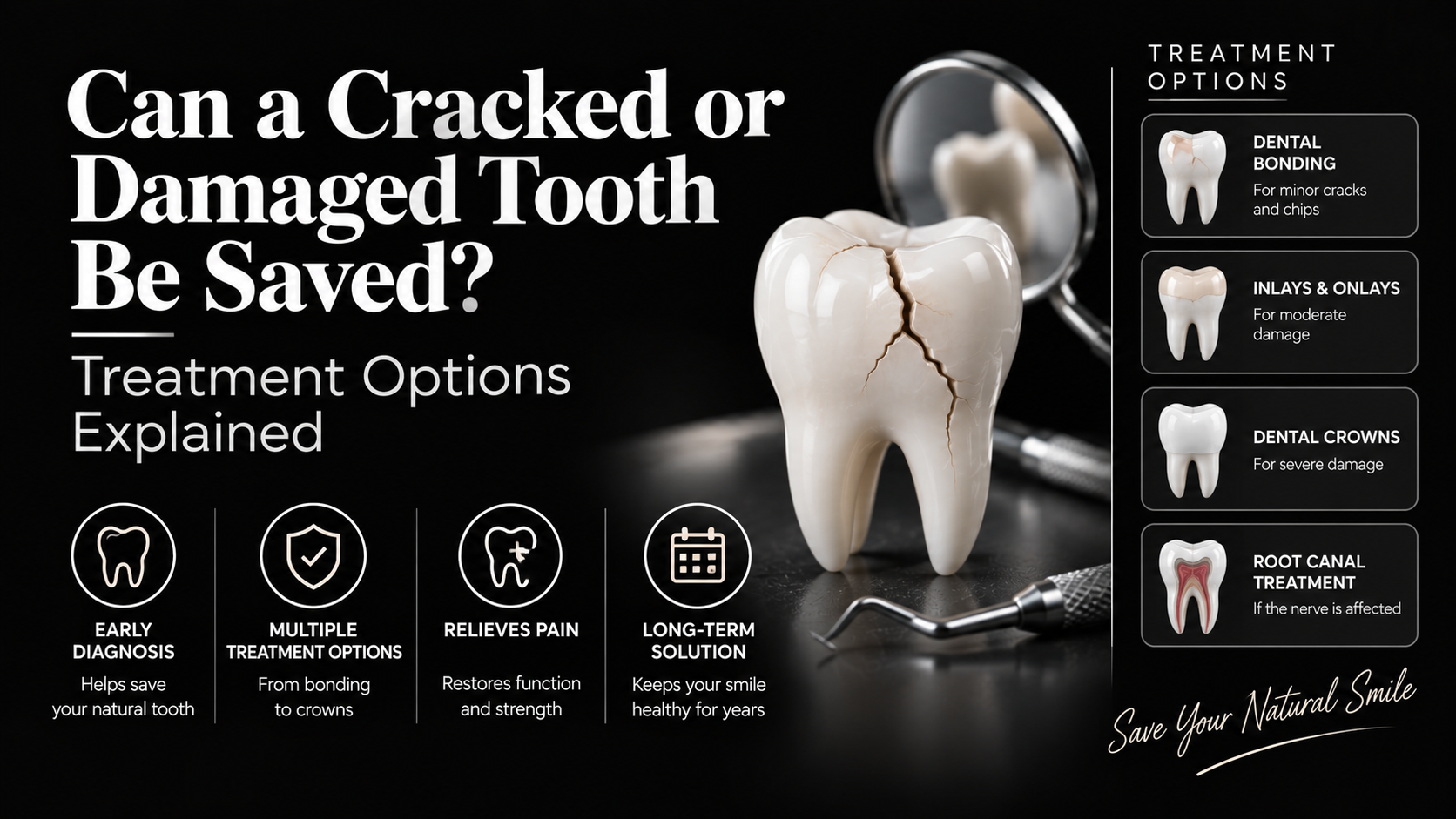
Dental Bonding or Tooth-Coloured Restoration
For limited chips and small areas of damage, bonding or another tooth-coloured restoration may provide a conservative solution.
This approach can restore shape and appearance while retaining most of the original tooth structure. It is particularly useful when the underlying tooth is otherwise healthy.
Patients should understand that a bonded tooth still requires sensible care. Biting hard foods on a repaired edge or using the tooth as a tool can cause the restoration to chip or detach.
Root Canal Treatment
A damaged tooth can sometimes develop pulp inflammation or infection. Symptoms may include lingering sensitivity, spontaneous pain, pain while chewing, or swelling around the tooth.
In these circumstances, root canal treatment in Hyderabad may be considered when the tooth remains restorable.
Root canal treatment is fundamentally a tooth-preserving procedure. It addresses the diseased tissue inside the tooth rather than immediately removing the entire tooth.
After the root canal, the dentist evaluates the remaining structure and determines whether a crown or another restoration is needed to protect the tooth.
Dental Crown
A dental crown can provide coverage and protection for a tooth that has lost significant structural integrity but remains suitable for restoration.
The decision to place a crown depends on factors such as the amount of remaining tooth structure, tooth location, biting forces, and the condition of the supporting tissues.
Patients should also consider the importance of the final bite. A crown that looks attractive but interferes with normal chewing can create unnecessary functional problems.
Extraction and Tooth Replacement
Unfortunately, some cracks cannot be repaired predictably. A severe fracture extending into the root or an area that cannot be properly sealed and restored may mean that extraction is necessary.
Once the tooth is removed, replacing the missing tooth becomes important for both function and overall dental planning.
For a single missing tooth, a single tooth dental implant can be considered when the patient has suitable bone and is otherwise clinically appropriate. American Smile Clinic describes single-tooth implants as one of its implant treatment options.
What Happens During an Examination for a Cracked Tooth?
Clinical Examination
The dentist first examines the affected tooth and surrounding tissues. Visible fractures, chips, gum changes, tenderness, and other clinical signs can provide important information about the condition of the tooth.
The dentist may also ask when the pain occurs, whether it is triggered by biting or temperature, and whether symptoms have changed over time.
Bite Assessment
A cracked tooth may react differently when pressure is applied in specific directions. Evaluating the patient’s bite can help identify whether excessive forces may be contributing to the problem.
This is particularly relevant for patients who grind or clench their teeth, as repeated high forces can place additional stress on weakened tooth structure.
Dental Imaging
X-rays can help assess the tooth and supporting bone. In more complex cases, additional imaging may be considered to understand the anatomy in greater detail.
American Smile Clinic highlights digital diagnostics and CBCT-based planning within its implant dentistry workflow.
Can a Damaged Tooth Become Infected?
Yes. Damage that reaches the inner tooth can create a pathway for bacteria to affect the pulp. If the pulp becomes infected and treatment is delayed, the infection can extend beyond the tooth and affect surrounding tissues.
Not every crack leads to infection, but symptoms such as swelling, persistent toothache, prolonged hot or cold sensitivity, or pain while chewing deserve professional evaluation.
This is one reason early dental assessment is useful. Treating a problem while the tooth is still restorable may provide more options than waiting until the damage becomes extensive.
When Should You See a Dentist for a Cracked Tooth?
A dental examination is particularly important when a crack is accompanied by pain, sensitivity, swelling, bleeding around the tooth, or difficulty chewing.
Even when there is no significant pain, a visible fracture should not automatically be ignored. Some cracks remain relatively stable, while others may progress under repeated chewing forces.
Patients should avoid diagnosing the severity of a fracture based only on what they can see in a mirror. A professional examination provides a more reliable basis for deciding whether the tooth can be monitored, restored, treated internally, or replaced.
How to Protect a Cracked or Restored Tooth
Avoid Hard and Sticky Foods
Until the tooth has been evaluated, avoid placing unnecessary pressure on it. Hard foods, ice, very sticky sweets, and other challenging foods can increase stress on a weakened structure.
Do Not Use Teeth as Tools
Opening packets, cutting thread, biting nails, or holding objects with the teeth can create concentrated forces that may worsen a damaged tooth.
Address Grinding and Clenching
Patients who grind or clench their teeth may put additional strain on cracked teeth and restorations. Your dentist can assess the bite and discuss protective options when appropriate.
Maintain Good Oral Hygiene
A damaged tooth still needs careful daily cleaning. Brushing and cleaning between the teeth help maintain healthy gums and reduce plaque accumulation around the affected area.
Professional teeth cleaning in Hyderabad can also form part of preventive dental care when recommended. American Smile Clinic describes professional cleaning as a way to remove plaque and tartar and assess gum health.
What If Several Teeth Are Damaged or Missing?
When only one tooth is damaged, treatment can often focus on that individual tooth. When several teeth are failing or missing, however, a broader restorative strategy may be more appropriate.
Patients with extensive tooth loss may be evaluated for full-mouth dental implants. American Smile Clinic describes full-mouth implant treatment as an option for replacing an entire upper or lower set of teeth using strategically placed implants and fixed restorations.
This type of treatment involves considerably more planning than replacing a single tooth. Bone condition, bite, facial structure, implant positioning, and the design of the final restoration all need to be considered together.
For patients whose concern is primarily cosmetic rather than structural, cosmetic dentistry in Hyderabad may also be relevant when appropriate. American Smile Clinic describes its cosmetic dentistry approach as combining aesthetic planning with functional and clinical considerations.
Choosing Between Saving and Replacing a Tooth
Preserve the Natural Tooth When It Is Predictably Restorable
When a tooth has enough healthy structure and its condition can be treated predictably, preservation may be preferable to extraction.
However, preserving a tooth should not mean accepting an uncertain long-term prognosis. The dentist must consider whether the proposed treatment can provide adequate stability and function.
Understand the Long-Term Maintenance
A restored natural tooth requires regular oral hygiene and professional care. Dental implants also require maintenance and periodic evaluation.
Neither option should be considered completely maintenance-free.
Think Beyond Appearance
A damaged front tooth may create an immediate cosmetic concern, but treatment should also account for chewing forces, speech, bite, gum health, and the condition of surrounding teeth.
The best restorative plan is one that addresses the tooth as part of the patient’s overall oral function rather than treating appearance in isolation.
Frequently Asked Questions About Cracked and Damaged Teeth
Can a cracked tooth heal on its own?
A structural crack in a tooth does not normally heal in the same way that damaged skin can heal. The crack may remain and can potentially progress under repeated biting forces. A dental examination can determine whether monitoring or active treatment is appropriate.
Does every cracked tooth need a root canal?
No. Root canal treatment is generally considered when the pulp has become inflamed or infected or when the clinical condition indicates that internal treatment is necessary. A superficial crack or small enamel chip may not require a root canal.
Can a tooth with a deep crack still be saved?
It depends on where the crack extends and how much healthy tooth structure remains. Some deeper cracks can be treated and restored, while fractures extending into the root or other non-restorable areas may require extraction.
Is a crown enough to fix a cracked tooth?
A crown may help protect a weakened tooth when the underlying structure is suitable. It cannot, however, make every type of crack restorable. The dentist must first determine whether the tooth has a predictable prognosis.
What happens if a cracked tooth is left untreated?
A crack can potentially become more extensive, leading to worsening symptoms, pulp damage, infection, or loss of restorable tooth structure. Early evaluation is therefore important, especially when pain or sensitivity is present.
Is a dental implant better than saving a natural tooth?
Not necessarily. If the natural tooth can be predictably restored, preserving it may be an appropriate option. When a tooth cannot be reliably saved, an implant can provide a replacement option for suitable patients. The choice depends on the individual’s clinical condition.
How can I protect a damaged tooth while waiting for an appointment?
Avoid chewing hard foods on that side, do not use the tooth as a tool, and maintain gentle oral hygiene. If the tooth becomes painful, swollen, or suddenly changes, contact a dental professional promptly.
Protecting Your Natural Smile Starts With Early Assessment
A cracked or damaged tooth is not automatically a lost tooth. The right treatment depends on the extent of the damage, the condition of the pulp and supporting tissues, and how much healthy structure remains.
From conservative restorations and root canal treatment to crowns and, when necessary, dental implants in Hyderabad, modern dentistry offers several approaches to managing damaged teeth.
For patients with more extensive tooth loss, full-mouth dental implants may form part of a comprehensive restorative plan. For appearance-focused concerns, cosmetic dentistry can be considered where clinically appropriate.
The most important step is early assessment. Instead of waiting for a damaged tooth to become more painful or difficult to restore, a professional examination can help establish whether the natural tooth can be preserved and which treatment offers the most appropriate long-term solution.
American Smile Clinic provides restorative, root canal, implant, cosmetic, and preventive dental services in Hyderabad, with treatment planning based on individual clinical needs.