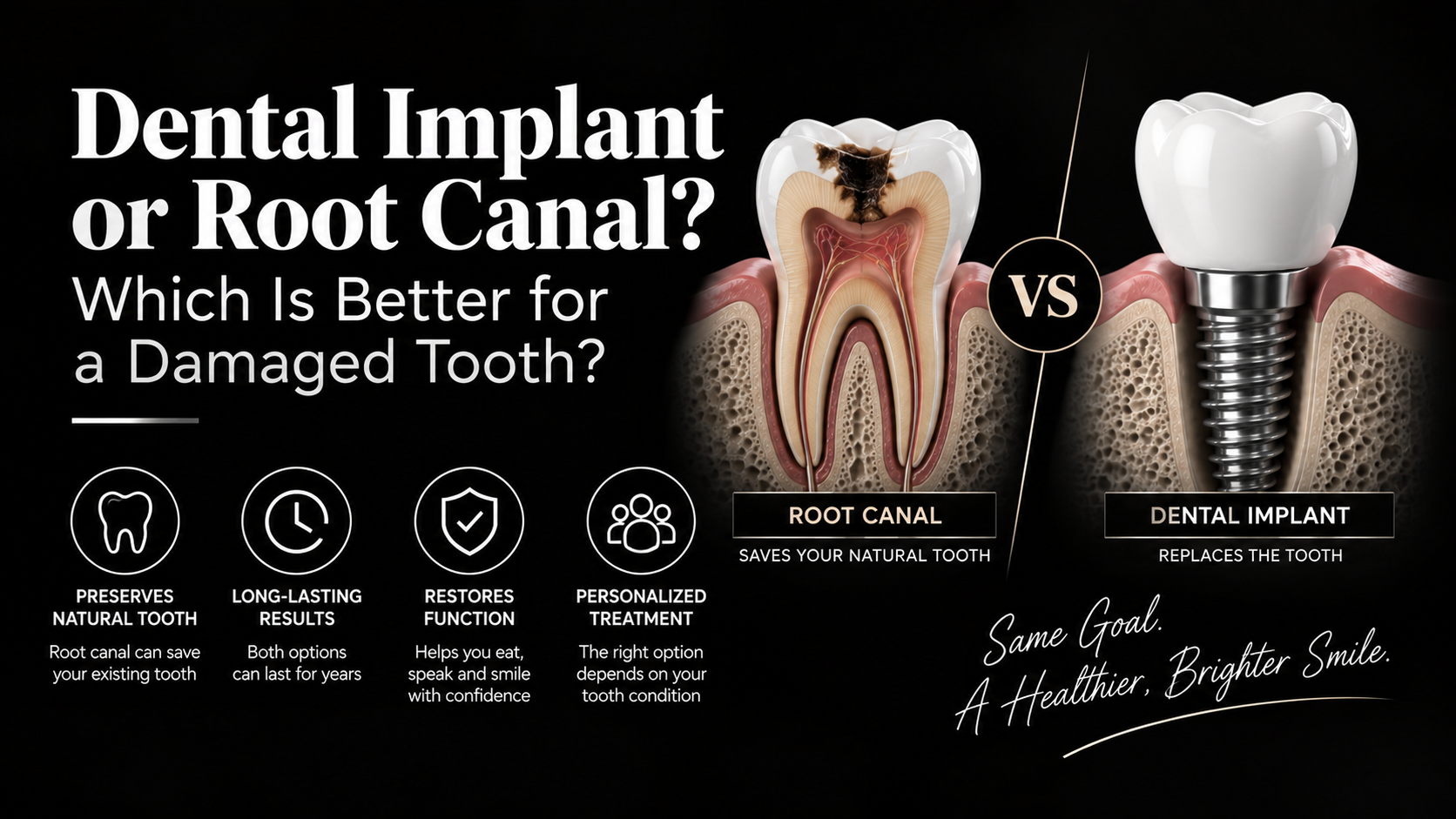
When a tooth is badly damaged, one of the biggest questions patients face is whether it can still be saved or whether it should be removed and replaced. The choice between a root canal and a dental implant is not simply a matter of comparing two treatments. These procedures address very different situations: a root canal aims to preserve the natural tooth, while an implant replaces a tooth that is no longer considered predictably restorable.
For anyone looking for a dentist in Hyderabad, the most useful starting point is a proper diagnosis. A cracked, deeply decayed, or infected tooth may still have enough healthy structure to support restoration, while another tooth with a severe fracture or poor prognosis may be better managed through extraction and replacement.
Understanding how each option works and when one becomes more appropriate than the other can make an important dental decision feel considerably clearer.
Root Canal vs Dental Implant: What Is the Difference?
A root canal treats the inside of an existing tooth. When the dental pulp becomes inflamed or infected, the damaged tissue is removed, the canals are cleaned and sealed, and the remaining tooth is restored.
A dental implant takes a different approach. Instead of treating the existing tooth, the damaged tooth is removed when necessary, and an implant is placed in the jaw to serve as a foundation for a replacement tooth.
At American Smile Clinic, root canal treatment in Hyderabad is described as a tooth-preserving procedure for teeth affected by pulp inflammation or infection, while the clinic’s dental implants in Hyderabad service is designed for replacing missing teeth.
The better choice therefore depends first on one question: Can the natural tooth be restored predictably?
When Is Root Canal Treatment the Better Option?
When the natural tooth has enough healthy structure and the supporting tissues remain suitable, preserving it can be an attractive option.
The Tooth Is Structurally Restorable
A root canal does not rebuild a tooth that has lost all of its structural integrity. It treats the infected or inflamed pulp inside it. If the tooth can still support a restoration after treatment, preserving it may make sense.
American Smile Clinic explains that root canal treatment removes infected pulp, cleans and disinfects the canals, seals the tooth, and may be followed by a custom-designed crown to restore strength and function.
The Main Problem Is Infection Inside the Tooth
Typical symptoms associated with pulp involvement can include lingering sensitivity to hot or cold, pain when chewing, severe toothache, swelling, or tenderness. These symptoms do not automatically mean a root canal is required, but they warrant professional evaluation.
The important distinction is that root canal therapy addresses the internal source of the problem while allowing the natural tooth to remain in place.
Preserving Natural Tooth Structure Is Possible
When a dentist can keep the tooth functional and stable, there may be value in retaining the natural root and surrounding anatomy rather than extracting the tooth.
A restored natural tooth still needs careful maintenance, but preserving it can avoid the need for implant surgery when there is no clinical reason to remove it.
When Might a Dental Implant Be the Better Option?
An implant generally enters the conversation when the natural tooth cannot be predictably saved.
The Tooth Has a Severe or Unrestorable Fracture
Not every crack can be treated with a root canal. A fracture extending through the root or into an area that cannot be properly restored may leave the tooth with a poor long-term prognosis.
In such circumstances, repeatedly treating or rebuilding the tooth may not provide a predictable solution. Extraction followed by replacement may be considered instead.
Too Little Healthy Tooth Structure Remains
A root canal can remove infected pulp, but it cannot replace missing tooth structure. If too much of the crown or root has been destroyed, there may not be enough remaining structure to support a durable restoration.
This is where extraction and replacement may become more logical than trying to preserve a tooth that no longer has a sound foundation.
The Tooth Has Failed Previous Treatment
Some teeth have already undergone extensive restorations, previous root canal therapy, or repeated repairs. If the remaining structure is severely compromised, the dentist may determine that replacing the tooth offers a more predictable path.
For patients who eventually need tooth replacement, American Smile Clinic provides single tooth dental implants as part of its implant treatment options.
Dental Implant or Root Canal: Which Is Better?
There is no universal winner. The appropriate treatment depends on the condition of the individual tooth.
Root Canal: The Tooth-Preserving Approach
Root canal treatment may be appropriate when:
- The tooth has infected or inflamed pulp.
- Enough healthy tooth structure remains.
- The tooth can be properly restored.
- The supporting bone and gums are suitable.
- The long-term prognosis is considered reasonable.
The practical advantage is straightforward: the natural tooth remains in the mouth.
It is also worth remembering that a root canal is often only one stage of treatment. A significantly weakened tooth may need a crown afterward to protect the remaining structure.
Dental Implant: The Tooth-Replacement Approach
A dental implant may be considered when:
- The tooth cannot be predictably restored.
- The tooth has a severe fracture.
- The remaining tooth structure is inadequate.
- Previous treatment has failed and the prognosis is poor.
- Extraction has become necessary.
The implant itself replaces the missing tooth’s root portion, with a restoration attached above it. American Smile Clinic uses digital planning and CBCT-based evaluation as part of its implant treatment workflow.
For a single missing tooth, a single tooth dental implant in Hyderabad is the most directly relevant implant option on the clinic’s website.
How Crowns Fit Into the Decision
Patients sometimes think the choice is simply “root canal or implant,” but the actual treatment pathway can involve several stages.
A tooth that receives a root canal may need a crown to restore and protect it. Conversely, an implant requires a prosthetic tooth above the implant.
American Smile Clinic also offers dental crowns and bridges in Hyderabad, making this an important related option when discussing the restoration of damaged teeth.
The decision should therefore consider the complete treatment sequence rather than focusing on the first procedure alone.
What Factors Does a Dentist Consider?
Location of the Damage
A crack or fracture in the crown of the tooth is different from one extending into the root. The exact location can significantly affect whether the tooth is restorable.
Amount of Remaining Tooth Structure
A tooth with substantial healthy structure may be easier to restore than one that has broken down through years of decay, trauma, or repeated dental work.
Condition of the Pulp
If the pulp is infected or irreversibly inflamed, root canal treatment may be considered when the rest of the tooth remains suitable for restoration.
Gum and Bone Health
The supporting tissues matter for both natural teeth and implants. Gum inflammation or significant bone loss may need attention as part of the overall treatment plan.
Bite and Functional Load
A molar exposed to heavy chewing forces presents different functional demands from a front tooth. Grinding and clenching can also influence restoration planning.
Long-Term Prognosis
Perhaps the most important question is not “Which treatment is quicker?” but “Which option gives this particular tooth the most predictable long-term outlook?”
What If Several Teeth Are Damaged?
A single damaged tooth can usually be assessed independently, but multiple failing or heavily restored teeth may require a broader strategy.
American Smile Clinic’s full mouth rehabilitation in Hyderabad combines restorative procedures such as crowns, bridges, implants, veneers, bite correction, and gum treatments when a comprehensive reconstruction is appropriate.
Similarly, patients with extensive tooth loss may be assessed for full mouth dental implants in Hyderabad.
This broader planning can be particularly important when several teeth have different prognoses. Saving one tooth may make sense while replacing another, rather than automatically choosing the same treatment for every tooth.
Does a Root Canal Last as Long as a Dental Implant?
Both treatments can provide long-term solutions, but their maintenance and potential complications are different.
A root-treated tooth remains a natural tooth and can still be affected by fracture, decay, gum disease, or restoration failure. It therefore needs regular oral hygiene and routine dental care.
A dental implant cannot develop a conventional cavity because it is not a natural tooth, but the tissues around an implant still require attention. The implant restoration can also experience wear or mechanical complications over time.
The longevity of either treatment depends on factors such as planning, restoration quality, oral hygiene, bite forces, and follow-up care.
Can Sedation Be Used for Root Canal or Implant Treatment?
Some patients feel anxious about lengthy or invasive dental procedures. American Smile Clinic lists sedation dentistry among its services and describes it as an option to help patients remain calm during dental procedures.
Whether sedation is appropriate depends on the patient’s medical history, the procedure, and the sedation method being considered. It should be discussed during treatment planning rather than assumed to be necessary for every patient.
Practical Guide: Questions to Ask Before Choosing
Ask Whether the Tooth Is Predictably Restorable
This should be the first question. The issue is not simply whether something can technically be done, but whether the result is likely to remain functional.
Ask What Happens After the Root Canal
Find out whether a crown or another restoration will be needed and how the tooth will be protected afterward.
Ask What Extraction Would Involve
If the tooth cannot be saved, ask about replacement choices, healing, implant planning, and the expected sequence of treatment.
Compare the Complete Treatment Plan
Consider the number of appointments, restoration requirements, maintenance, recovery, and long-term goals rather than comparing the two procedures as isolated events.
Frequently Asked Questions
Is a root canal better than a dental implant?
Neither treatment is automatically better. A root canal may be preferable when a natural tooth can be predictably restored. An implant becomes relevant when the tooth is no longer restorable or extraction is necessary.
Can a badly damaged tooth be saved with a root canal?
Sometimes. If the damage is primarily inside the tooth and enough healthy structure remains, root canal treatment may allow the tooth to be preserved. A severe structural fracture can make the prognosis much less favourable.
Is an implant necessary after every failed root canal?
Not necessarily. The reason for treatment failure needs to be established first. Some teeth may be retreatable or surgically manageable, while others may be too structurally compromised to preserve.
Which is more natural, a root canal or an implant?
A successfully treated root canal preserves the patient’s natural tooth, so the tooth itself remains natural. An implant replaces the missing tooth with an artificial root and restoration. The final appearance and function depend heavily on the restoration and overall treatment planning.
How do I know whether my damaged tooth needs extraction?
You cannot reliably determine this from symptoms or appearance alone. A dentist needs to assess the crack, remaining tooth structure, pulp, supporting tissues, and overall prognosis before recommending extraction.
Can a crown save a damaged tooth without a root canal?
In selected cases, yes. A crown may protect a structurally weakened tooth when the pulp is healthy and there is enough sound tooth structure. If the pulp is infected or irreversibly inflamed, a root canal may be required before definitive restoration.
What if I have several failing teeth?
A comprehensive assessment may be more useful than treating each tooth separately. Depending on the condition of the teeth, options can include restorative treatment, crowns and bridges, implants, or a broader full mouth rehabilitation.
Making the Right Choice for a Damaged Tooth
The decision between a dental implant and a root canal should begin with preservation not replacement when a natural tooth has a reasonable, predictable prognosis. Root canal treatment is intended to address infection or inflammation inside the tooth while retaining the tooth itself. An implant serves a different purpose: replacing a tooth that can no longer be predictably maintained.