
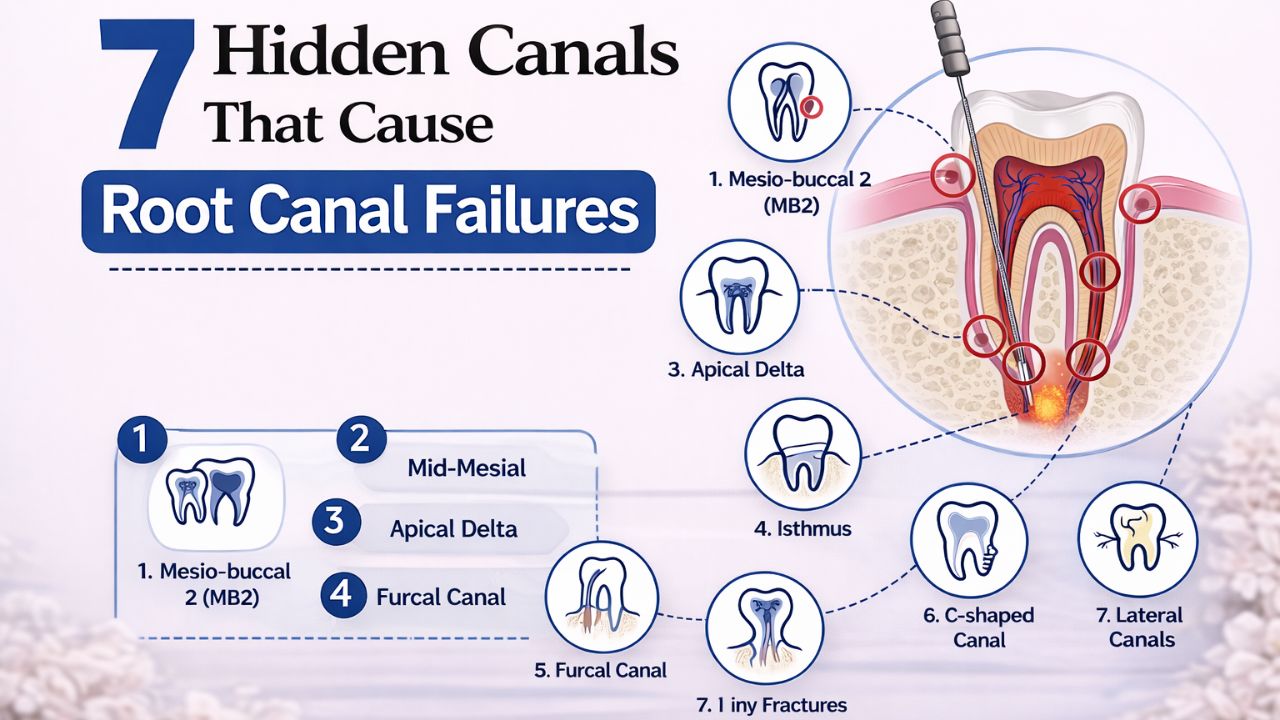
Root canal failure is rarely about the material used or the procedure itself—it’s most often about what gets missed. Inside every tooth lies a complex network of canals, and not all of them are easy to detect. When even one canal is left untreated, bacteria can remain, leading to persistent infection and eventual failure.
At our American Smile Clinic, root canal treatment is approached with a strong focus on precision and complete diagnosis. By Dr. Srikanth’s experience, one of the most common reasons for retreatment is missed or hidden canals that were not identified during the initial procedure. Understanding these hidden canals can help patients appreciate why advanced diagnostics and expertise matter.
1. The MB2 Canal in Upper Molars
One of the most commonly missed canals is the second mesiobuccal canal (MB2) in upper molars.
Why it’s often missed:
- Extremely small and narrow
- Positioned deep within the tooth
- Not always visible without magnification
Missing the MB2 canal is a leading cause of root canal failure in upper molars.
2. Additional Canals in Lower Molars
Lower molars may appear straightforward but often contain extra canals beyond the usual two or three.
Common variations include:
- A fourth canal
- Split canals within the same root
- Complex branching systems
Without careful examination, these canals can easily go untreated.
3. Hidden Lingual Canals in Front Teeth
Front teeth are often assumed to have a single canal, but that’s not always the case.
Some may have:
- A second lingual canal (toward the tongue side)
- Narrow bifurcated canals
Because of their small size, these canals are frequently overlooked.
4. Calcified or Narrowed Canals
Over time, canals can become calcified, making them extremely difficult to detect.
These canals:
- Appear almost invisible in standard imaging
- Require advanced techniques to locate
- Are often missed in routine procedures
At our clinic, digital diagnostics and precision tools help identify these challenging cases.
5. Lateral and Accessory Canals
Not all canals run straight from top to bottom. Some branch out sideways as lateral or accessory canals.
These can:
- Harbor bacteria even after main canal cleaning
- Cause persistent infection if untreated
- Be difficult to detect without magnification
While not all require direct treatment, their presence influences how thoroughly the main canal is cleaned.
6. Curved or Complex Canal Anatomy
Some canals are not straight—they curve, twist, or divide unexpectedly.
This complexity can lead to:
- Incomplete cleaning
- Difficulty reaching the full length of the canal
- Increased risk of leaving infected areas behind
By Dr. Srikanth’s approach, understanding canal anatomy before treatment is critical to avoid such issues.
7. Previously Missed Canals in Failed Treatments
In many retreatment cases, the cause of failure is not a new problem—it’s a canal that was missed the first time.
These cases often involve:
- Hidden canals that were not detected earlier
- Incomplete cleaning of complex anatomy
- Persistent infection due to untreated spaces
At our American Smile Clinic, retreatment cases are carefully evaluated to identify and address these missed canals with precision.
Why Hidden Canals Matter So Much
Root canal treatment is successful only when all infected canals are identified, cleaned, and sealed properly. Missing even one canal can allow bacteria to remain and multiply, leading to:
- Recurring pain
- Swelling or infection
- Need for retreatment or extraction
This is why advanced tools, detailed diagnosis, and clinical expertise are essential—not optional.
How Modern Dentistry Prevents Missed Canals
Today, root canal treatment has evolved significantly with the help of advanced technology.
At our American Smile Clinic, this includes:
- Digital 3D imaging for accurate diagnosis
- Enhanced magnification for better visibility
- Precision-driven treatment planning
- Thorough cleaning and sealing techniques
This approach minimizes the chances of missing hidden canals and improves long-term success.
Final Thoughts
Hidden canals are one of the most overlooked reasons for root canal failure, yet they play a crucial role in treatment outcomes. What may seem like a routine procedure can quickly become complex if canal anatomy is not fully understood.
By Dr. Srikanth’s experience, the key to successful root canal treatment lies in seeing more, understanding more, and treating more precisely. At our American Smile Clinic, every effort is made to ensure that no detail is missed—because in root canal treatment, even the smallest canal can make the biggest difference.
FAQs – Hidden Canals & Root Canal Treatment
Can missed canals really cause root canal failure?
Yes, untreated canals can retain bacteria, leading to infection and failure.
How are hidden canals detected?
Advanced imaging and magnification tools help identify complex canal structures.
Is retreatment always required if a canal is missed?
In many cases, retreatment is needed to clean and seal the missed canal.
Are all teeth likely to have hidden canals?
Not all, but many teeth—especially molars—can have complex anatomy.
Can modern technology completely prevent missed canals?
It significantly reduces the risk, but expertise and careful planning are equally important.