
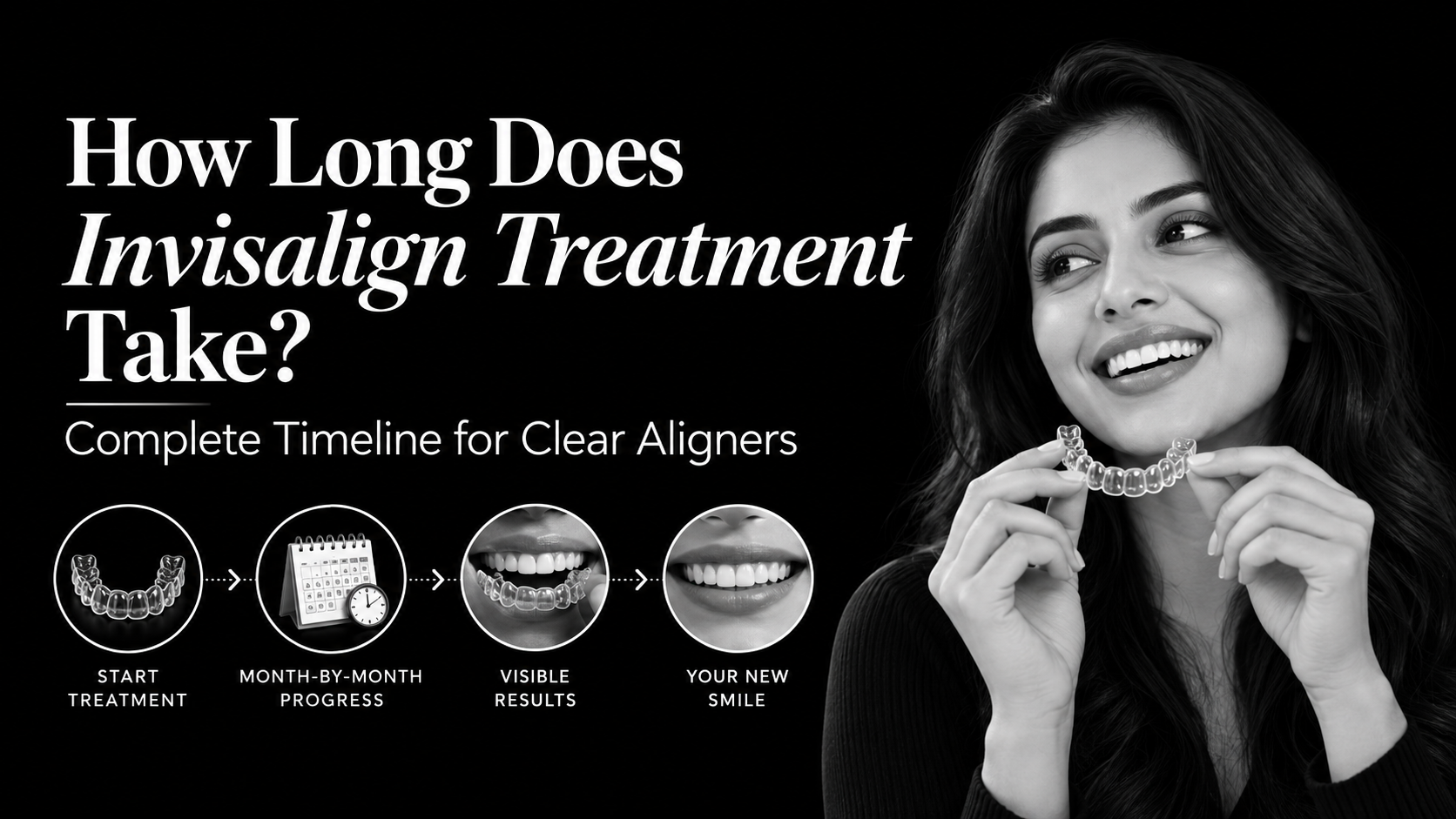
One of the first questions people ask before choosing clear aligners is simple: How long does Invisalign treatment take?
The answer depends on more than just how crooked your teeth look. Your starting alignment, bite, treatment goals, biological response, daily aligner wear, and the number of movements required can all influence the timeline.
At American Smile Clinic, Invisalign treatment is planned around the individual patient’s teeth, bite, smile goals, and long-term stability. The clinic’s Invisalign guidance indicates that treatment may take approximately 4 to 18 months, while a typical treatment period can fall around 6 to 18 months depending on case complexity.
But the treatment journey is about more than counting months. It involves consultation, digital planning, customized aligners, regular tray changes, progress monitoring, possible refinements, and finally retention.
Here is what the complete Invisalign timeline can look like.
How Long Does Invisalign Treatment Usually Take?
For many patients, Invisalign treatment takes approximately 6 to 18 months. Relatively minor cosmetic alignment may sometimes be completed in a shorter period, while more complex cases can require considerably longer.
American Smile Clinic’s published Invisalign information gives an overall treatment range of approximately 4–18 months, depending on the complexity of the case.
A simplified guide looks like this:
| Type of Alignment Concern | Possible Treatment Timeline |
| Minor cosmetic adjustments | Around 4–6 months |
| Mild crowding or spacing | Around 6–9 months |
| Moderate alignment concerns | Around 9–15 months |
| More complex cases | Around 15–18+ months |
These figures are only general examples. Your dentist can provide a more accurate estimate after evaluating your teeth and planning the required movements.
Why Does Invisalign Take Different Amounts of Time for Different People?
Two people can choose Invisalign and still have completely different treatment timelines.
Several factors influence the duration.
1. The Severity of Misalignment
Small gaps or mild crowding may require fewer stages of tooth movement.
More pronounced crowding, spacing, or complex alignment problems may require a longer sequence of aligners.
American Smile Clinic describes clear aligners as an option for concerns such as crooked or crowded teeth, spacing, mild-to-moderate bite problems, and orthodontic relapse.
2. Your Bite
Straightening the visible front teeth is not always the only objective.
If your upper and lower teeth do not meet properly, the treatment plan may need to address bite relationships as well. More complex bite corrections can increase the number of treatment stages required.
3. How Consistently You Wear Your Aligners
This is one of the factors that patients can directly control.
American Smile Clinic recommends wearing clear aligners for approximately 20–22 hours per day. They are generally removed for eating, drinking anything other than water, and oral hygiene.
Wearing your aligners consistently helps your teeth follow the planned sequence of movement.
4. How Frequently You Change Aligners
Clear aligner treatment works through a sequence of trays rather than one appliance worn throughout the entire treatment.
At American Smile Clinic, aligners are generally changed approximately every 1–2 weeks, depending on the treatment plan.
Each new tray is designed to continue the progression from the previous stage.
5. How Your Teeth Respond
Teeth do not move at exactly the same speed in every person.
The position of individual teeth, the type of movement required, your biology, and your overall oral health can all influence treatment progress.
The Complete Invisalign Treatment Timeline
Understanding each stage makes the overall process easier to visualize.
Stage 1: Initial Consultation
Timeline: Before active treatment
Your Invisalign journey begins with an evaluation.
The dentist examines your teeth, bite, alignment, and smile goals to determine whether clear aligners are appropriate for your case.
This is also when you can discuss:
- What you want to change
- Which teeth need movement
- Whether your bite needs correction
- Your expected treatment duration
- Your lifestyle and treatment preferences
- The estimated number of aligners
- Your expected treatment cost
The goal is not simply to make teeth look straighter. A good treatment plan should also consider function, facial proportions, oral health, and long-term stability.
Stage 2: Digital Scanning and Treatment Planning
Timeline: Early treatment phase
Once Invisalign is considered suitable, digital records can be created.
American Smile Clinic uses digital treatment planning to analyze the patient’s teeth and create a personalized sequence of tooth movements.
Digital planning can help the dentist visualize how the teeth are expected to move from their current positions toward the planned result.
This can be particularly useful when Invisalign forms part of a broader smile designing treatment, where facial proportions, tooth shape, alignment, and overall smile aesthetics may be considered together.
Stage 3: Your Custom Aligners Are Prepared
Timeline: After treatment planning
Once the treatment sequence has been established, your clear aligners are prepared according to the planned movements.
Unlike traditional braces, aligners are removable trays that fit over the teeth.
Each tray is designed to make a controlled adjustment. You then progress through a series of trays until the planned alignment is achieved.
Stage 4: You Begin Wearing Your First Aligners
Timeline: Start of active treatment
Once your aligners are ready, active treatment begins.
The recommended daily wear time is approximately 20–22 hours.
You remove the aligners for meals, drinks other than water, and brushing and flossing.
Because they are removable, clear aligners can make it easier to maintain your normal oral-hygiene routine compared with fixed orthodontic appliances.
Stage 5: You Change Aligners Every 1–2 Weeks
Timeline: Throughout active treatment
This is where most of the gradual transformation happens.
Each aligner is designed to move the teeth slightly. After approximately one to two weeks, you generally move to the next tray according to your dentist’s instructions.
The process can be visualized as:
Aligner 1 → Aligner 2 → Aligner 3 → Aligner 4 → continuing through the treatment sequence
The actual number of aligners depends entirely on the individual case.
Stage 6: Regular Progress Monitoring
Timeline: Throughout treatment
Invisalign is not a treatment where you simply receive a box of trays and wait until the end.
Your dentist needs to monitor how your teeth are responding.
Progress appointments allow the treatment team to evaluate whether the teeth are following the intended movement and whether any changes are needed.
Regular monitoring can also help identify issues such as poor aligner fit, insufficient wear, or movements that require additional attention.
Stage 7: Refinements, If Required
Timeline: During or toward the end of treatment
Some patients need additional aligners after completing their original sequence.
These are commonly referred to as refinements.
A refinement does not necessarily mean something went wrong. Teeth can respond differently from the original digital prediction, and additional adjustments may be useful for achieving the desired final position.
The need for refinements depends on the complexity of the case and how the teeth respond during treatment.
Stage 8: Final Alignment
Timeline: End of active treatment
Once your teeth reach their planned positions, active Invisalign treatment comes to an end.
But your orthodontic journey is not quite finished.
The next stage is retention.
Stage 9: Retainers
Timeline: After active treatment
Teeth can naturally move after orthodontic treatment.
Retainers are therefore an important part of maintaining your result.
Your dentist will recommend a retainer schedule based on your individual situation. Following that plan helps protect the alignment achieved through your Invisalign treatment.
How Long Does Each Invisalign Stage Take?
| Treatment Stage | Typical Timing |
| Initial consultation | One appointment |
| Digital scanning and planning | Early treatment |
| Custom aligners | After treatment planning |
| Active Invisalign treatment | Approximately 4–18 months |
| Aligner changes | Every 1–2 weeks |
| Progress monitoring | Throughout treatment |
| Refinements | If required |
| Retention | Long-term |
The active treatment stage is the part that varies most significantly from patient to patient.
Can Invisalign Treatment Be Completed in 6 Months?
It can be possible for patients with relatively minor alignment concerns.
A patient with small gaps, mild crowding, or limited cosmetic adjustments may require considerably fewer stages than someone with complex bite or alignment problems.
However, choosing a treatment solely because it promises the shortest timeline is not always the best approach.
The objective should be to achieve the appropriate tooth positions while maintaining good bite function and long-term stability.
Can Invisalign Be Faster Than Traditional Braces?
Sometimes, but not necessarily in every case.
American Smile Clinic’s current braces information gives traditional orthodontic treatment a commonly cited range of around 12–24 months, depending on complexity, while its Invisalign guidance gives a range of approximately 4–18 months.
Patients considering both options can review the clinic’s teeth braces cost and treatment guide to understand the differences more clearly.
The right choice depends on the type of correction required, your lifestyle, aesthetics, budget, and your dentist’s clinical recommendation.
What Can Make Invisalign Treatment Take Longer?
Several factors can extend your treatment timeline.
Inconsistent Aligner Wear
If you regularly leave your aligners out for extended periods, the teeth may not progress according to the planned schedule.
Skipping or Changing Trays Incorrectly
Your aligners are designed to work in a specific sequence. Changing trays earlier than instructed or skipping stages can interfere with treatment progression.
Lost or Damaged Aligners
Losing an aligner can interrupt the planned sequence and may require additional instructions from your dentist.
Complex Tooth Movements
Some movements require more stages and more careful control than others.
Additional Refinements
If further adjustment is necessary at the end of the planned sequence, additional aligners may extend the total treatment period.
How Can You Help Keep Invisalign Treatment on Schedule?
Your daily habits can make a meaningful difference.
Wear Your Aligners Consistently
Aim for the recommended 20–22 hours per day.
Follow Your Tray Schedule
Change to your next aligner according to the schedule provided by your dentist.
Keep Your Aligners Clean
Clean your aligners regularly and maintain good oral hygiene.
Attend Progress Appointments
Regular appointments allow your dentist to check whether treatment is progressing as planned.
Store Your Aligners Safely
When you remove your aligners, keep them in their case rather than wrapping them in tissue or leaving them exposed.
Why Oral Hygiene Matters During Invisalign
Although clear aligners are removable, they do not eliminate the need for careful oral hygiene.
Food particles and plaque can remain against the teeth when aligners are placed over an unclean mouth.
Brushing and flossing regularly is therefore an important part of your treatment routine.
Professional cleaning can also help remove plaque, tartar, and surface stains that regular brushing may not completely eliminate. Patients can review American Smile Clinic’s teeth cleaning and pricing guide for more information.
Invisalign and Your Overall Smile Design
Straight teeth are only one part of an attractive smile.
The size and shape of the teeth, their proportions, colour, gum display, facial structure, and overall symmetry can also influence how a smile looks.
American Smile Clinic’s cosmetic dentistry approach considers these elements when planning aesthetic treatment.
Its cosmetic dentistry services include smile makeovers, teeth whitening, dental veneers, cosmetic bonding, gum contouring, and other aesthetic treatments.
This can be especially useful for patients who want to improve more than just tooth alignment.
Can Invisalign Be Part of a Smile Makeover?
Yes.
Invisalign can sometimes form one stage of a broader smile transformation.
For example, a patient may first need alignment correction before considering cosmetic treatments such as whitening, bonding, or veneers.
American Smile Clinic’s smile makeover treatment combines different cosmetic approaches according to the patient’s individual smile goals.
The sequence matters. In some cases, orthodontic alignment should be completed before cosmetic restorations are planned.
Invisalign vs. Teeth Whitening: What Problem Are You Trying to Solve?
It is important to distinguish between alignment and colour.
If your main concern is:
- Crooked teeth: Invisalign may be appropriate.
- Crowding: Clear aligners may help.
- Gaps caused by tooth position: Invisalign may help.
- Yellow or stained teeth: Whitening may be more appropriate.
- Chipped or unusually shaped teeth: Bonding or veneers may be considered.
- Multiple aesthetic concerns: A broader smile makeover may be appropriate.
American Smile Clinic provides professional teeth whitening treatment for patients whose primary concern is tooth colour rather than alignment.
In some cases, patients may ultimately benefit from combining alignment and cosmetic treatment.
Can Invisalign Improve a Smile Without Changing Tooth Colour?
Yes.
Clear aligners primarily change the position of teeth. They do not whiten the natural tooth surface.
This means a patient may finish Invisalign with beautifully aligned teeth but still have concerns about staining or discolouration.
If tooth colour remains a concern after alignment, professional whitening can be considered separately.
Invisalign and Smile Correction
Some patients use the term “smile correction” broadly to describe several different concerns, including crooked teeth, spacing, uneven teeth, discoloration, and bite-related issues.
American Smile Clinic’s current treatment information lists smile correction as a treatment category, with the approach depending on the combination of procedures required.
This is why a personalized consultation is more useful than choosing a treatment based on a single symptom.
A patient who describes their concern as a “crooked smile” may need Invisalign, braces, cosmetic bonding, veneers, or a combination of treatments depending on the underlying issue.
How Much Does Invisalign Cost in Hyderabad?
Treatment cost varies according to the complexity of the case, number of aligners, treatment duration, and other clinical factors.
American Smile Clinic’s current pricing information lists Invisalign clear aligners at approximately ₹1,20,000–₹3,50,000 in Hyderabad.
The final treatment cost depends on individual clinical requirements and the recommended treatment plan.
For a broader comparison of Invisalign, braces, whitening, smile designing, and other procedures, you can refer to the clinic’s latest dental treatment price guide for Hyderabad.
Is a Longer Invisalign Treatment More Expensive?
Not necessarily in a simple month-for-month way.
The total cost can be influenced by the complexity of your case, number of aligners, treatment planning, technology, and whether refinements or additional treatment are required.
A longer treatment may involve more stages, but the relationship between treatment duration and cost depends on the specific treatment plan.
The most reliable way to understand your expected cost is to receive a personalized assessment rather than relying solely on a general price range.
What Happens After Invisalign Treatment?
Finishing your final aligner is an important milestone, but retention is essential.
Without appropriate retention, teeth can gradually shift from their corrected positions.
Your dentist will recommend retainers and explain how they should be worn to maintain your results.
This is why Invisalign should be viewed as a complete treatment journey:
Consultation → Digital planning → Aligners → Progress monitoring → Refinement if needed → Final alignment → Retention
Invisalign for NRIs and International Patients
For patients travelling to Hyderabad for dental care, treatment planning and scheduling become particularly important.
American Smile Clinic specifically caters to NRIs and international patients and offers dental tourism services in Hyderabad, including pre-arrival treatment planning and virtual consultations.
For a treatment such as Invisalign, where appointments and monitoring may extend over several months, discussing the expected schedule before beginning treatment can be especially important for patients who live outside Hyderabad.
Frequently Asked Questions
How long does Invisalign treatment take?
American Smile Clinic’s published information indicates that Invisalign treatment can range from approximately 4 to 18 months, while a typical treatment period may fall around 6 to 18 months, depending on case complexity.
Can Invisalign treatment be completed in 6 months?
Some patients with mild alignment concerns may complete treatment in approximately six months. More complex cases can require considerably longer.
How many hours a day should I wear Invisalign?
American Smile Clinic recommends wearing clear aligners for approximately 20–22 hours per day.
How often do I change Invisalign aligners?
Aligners are generally changed approximately every 1–2 weeks, according to the treatment plan provided by your dentist.
Is Invisalign painful?
You may experience mild pressure or temporary discomfort when starting a new aligner because the tray is designed to move the teeth gradually. Significant or persistent pain should be discussed with your dentist.
Can Invisalign fix crowded teeth?
Clear aligners can be used for many cases of crooked and crowded teeth. However, suitability depends on the severity and type of crowding and whether additional bite correction is required.
Is Invisalign better than braces?
Neither treatment is automatically better for every patient. Invisalign offers a discreet, removable option, while traditional braces can be highly effective for a wide range of orthodontic problems. Your dentist can recommend the most appropriate approach for your specific case.
Does Invisalign whiten teeth?
No. Invisalign is designed primarily to move teeth into planned positions. It does not function as a professional whitening treatment.
Can Invisalign be combined with other cosmetic treatments?
Yes. Depending on your smile goals, alignment treatment may be combined with or followed by procedures such as professional whitening, bonding, veneers, or other cosmetic treatments.
Will my teeth stay straight after Invisalign?
Retainers are important for maintaining the alignment achieved through orthodontic treatment. Your dentist will recommend an appropriate retention plan based on your individual needs.
Final Thoughts
So, how long does Invisalign treatment take?
For many patients, the answer is approximately 6 to 18 months, although treatment can sometimes be shorter for minor corrections and longer for more complex cases.
The timeline depends on your starting alignment, bite, treatment goals, daily wear time, biological response, and whether additional refinement is necessary.
The shortest treatment is not necessarily the best treatment. What matters more is achieving controlled tooth movement, a balanced bite, an attractive smile, and long-term stability.
With digital planning and personalized treatment design, Invisalign can offer a discreet and flexible way to address many common alignment concerns.
At American Smile Clinic, the treatment journey can be planned around your individual smile and orthodontic needs rather than relying on a generic timeline.