
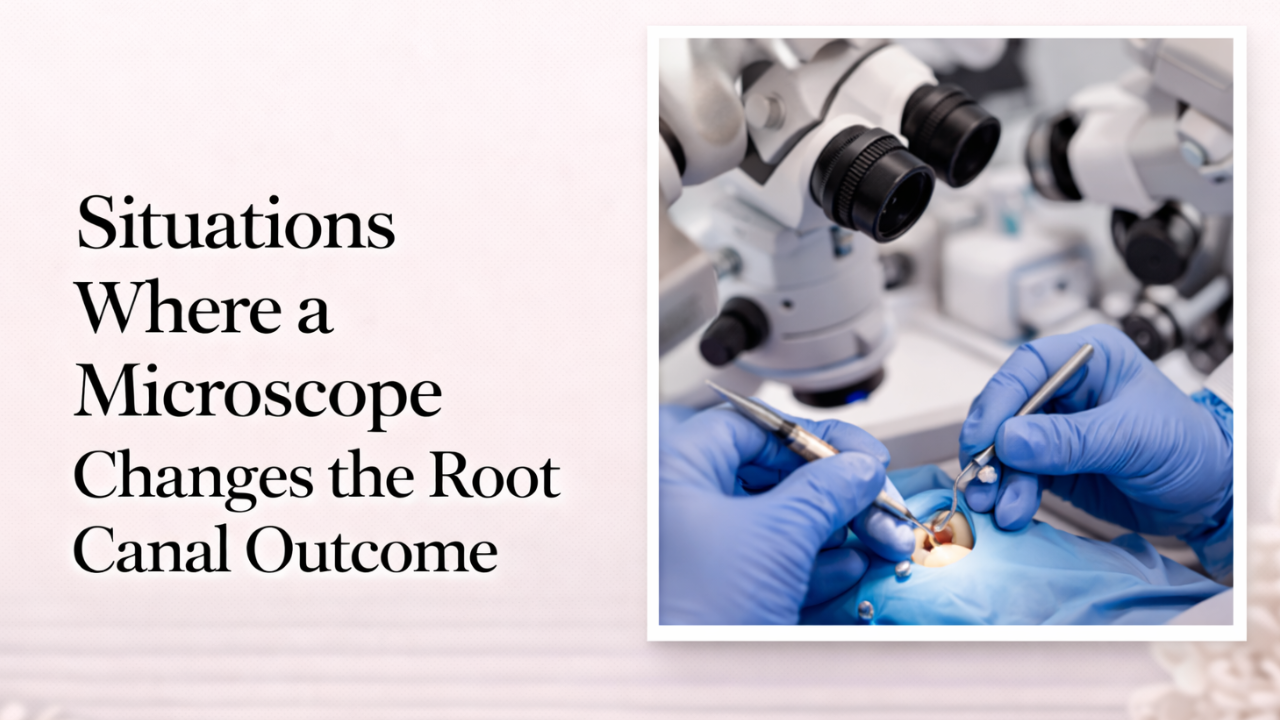
Root canal treatment today is very different from what it used to be. With advancements in technology, especially the use of dental microscopes, the accuracy and success rate of treatment have improved significantly. However, many patients don’t realize that a microscope isn’t just an “extra tool”—in certain situations, it can completely change the outcome of the procedure.
At our American Smile Clinic, root canal treatments are performed with a precision-driven approach, where magnification and visibility play a critical role. By Dr. Srikanth’s experience, using a dental microscope often makes the difference between a routine treatment and a highly successful one—especially in complex cases.
Here are seven situations where a microscope truly transforms root canal outcomes.
1. When Root Canals Are Extremely Narrow or Hidden
Not all canals inside a tooth are easy to locate. Some are extremely fine or hidden, especially in molars.
A microscope helps to:
- Identify extra or missed canals
- Improve visibility inside the tooth
- Prevent incomplete treatment
Missing even one canal can lead to failure—this is where magnification becomes essential.
2. In Re-Root Canal (Re-RCT) Cases
When a previous root canal has failed, the complexity increases. Old fillings, infections, or missed canals need to be addressed carefully.
With a microscope, dentists can:
- Locate previously missed canals
- Remove old filling material precisely
- Clean infected areas more effectively
At our clinic, this is especially important in retreatment cases where precision is critical.
3. When There Is a Deep Infection
Severe infections often extend deeper into the root structure, making them harder to clean completely.
Magnification allows:
- Better visualization of infected tissue
- Thorough cleaning of complex canal systems
- Reduced chances of reinfection
This improves long-term success and healing.
4. In Teeth with Complex Anatomy
Some teeth have curved, multiple, or unusually shaped canals. These variations are difficult to manage without enhanced visibility.
A microscope helps to:
- Navigate curved canals safely
- Avoid procedural errors
- Maintain the natural structure of the tooth
This is particularly important for back teeth, where anatomy is more complex.
5. When Removing Broken Instruments
Sometimes, small instruments used during root canal treatment can break inside the canal.
Without magnification, removal becomes risky.
With a microscope:
- The broken fragment can be clearly visualized
- Precision tools can be used safely
- Tooth damage is minimized
This significantly improves the chances of saving the tooth.
6. Detecting Cracks or Fractures in Teeth
Tiny cracks in teeth are often invisible to the naked eye but can affect treatment success.
A microscope allows:
- Early detection of micro-cracks
- Better treatment planning
- Avoidance of unnecessary procedures
By Dr. Srikanth’s approach, identifying these issues early helps in choosing the right treatment strategy.
7. Achieving Perfect Sealing of the Root Canal
The final step of root canal treatment is sealing the canal properly. Even small gaps can lead to reinfection.
With magnification:
- Filling is done with greater precision
- Gaps or voids are minimized
- Long-term success improves significantly
This is one of the most critical steps where a microscope directly impacts results.
Why Microscopic Root Canal Treatment Matters
Using a microscope is not about making the procedure more complex—it’s about making it more accurate and predictable.
At our American Smile Clinic, this approach ensures:
- Higher success rates
- Better preservation of natural teeth
- Reduced chances of retreatment
- More comfortable and efficient procedures
It reflects a shift from basic treatment to precision dentistry aligned with global standards.
Final Thoughts
Root canal treatment is no longer just about removing infection—it’s about doing it with accuracy, care, and long-term vision. In many cases, the difference between success and failure lies in what the dentist can actually see.
By Dr. Srikanth’s experience, the use of microscopes has redefined root canal outcomes—especially in complex or high-risk cases. For patients, this means better results, fewer complications, and greater confidence in their treatment.
FAQs – Microscopic Root Canal Treatment
Is a microscope necessary for every root canal?
Not always, but it is highly beneficial in complex or precision-sensitive cases.
Does using a microscope make the treatment safer?
Yes, it improves accuracy and reduces the risk of errors.
Is a microscopic root canal more expensive?
It may cost slightly more, but offers better long-term value and success.
Does it take longer than a normal root canal?
Not necessarily—better visibility often makes the procedure more efficient.
Is the procedure more comfortable?
Yes, precise treatment reduces unnecessary intervention and improves overall comfort.